
 iOS
iOS Android
 React Native
 Unity
Unity Flutter
 Ionic
Ionic IOT
IOT OTT
OTT Wearable
 Angular
 Python
 Vue.js
 Node.js
 PHP
PHP Laravel
 .Net
.Net WordPress
 Shopify
 Drupal
 Magento
 Social Media Marketing
 PPC Expert
 Content Writers
 GEO
GEO
 Virtual Assistants
 IT Support
 Customer Support
 Order Processing
 Contract Reviewers
 Logistics Coordinator
 eCommerce Solutions
 Bookkeeping
 Tax Preparation
 AR/AP Specialists
 Automation Testing
 Manual Testing
 AI Developer
 ML Developer
 RPA Developer
 UI/UX Designer
 Graphic Design
 Animation
 3D CAD
Do you know that the concept of mobile apps dates back as early as 1994? More than 30 years ago, IBM Simon, the first smartphone, came in with built-in apps like calendar, calculator, and notepad, and since then, the app development industry has seen a staggering growth! From earlier simplified mobile apps to contemporary multifunctional super apps, one concern that has remained constant is choosing the right app development frameworks.
As the digital market is becoming more competitive and saturated, businesses must rely on powerful and scalable mobile app development frameworks to gain an edge. The right mobile app development framework can considerably reduce your time-to-market while enhancing user compatibility, hence ensuring the success of your application.
Therefore, in 2025, selecting the ideal mobile app development framework is no longer a technical issue but a strategic decision capable of directly influencing your app’s success trajectory!
In this blog, we will list the top 10 programming frameworks for mobile app development to help you make a more informed choice for your business.
So, let’s get started.
What Are App Development Frameworks?
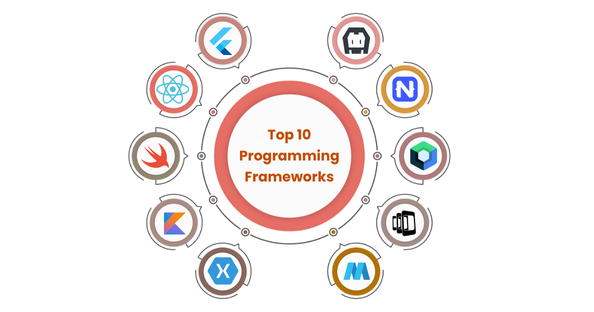
Before getting into the top 10 programming frameworks for app development in 2025, let’s briefly understand what mobile application development frameworks are and their uses.
App development frameworks are software tools that provide you with built-in components and an environment for efficient and standardized app creation.
These frameworks can support –
- Native
- Hybrid and
- Cross-platform app development.
With evolving mobile technology, mobile app development frameworks are also becoming versatile, and determining the best mobile app development platform aligned to your needs is where your product’s success is determined.
Top 10 Programming Frameworks for App Development in 2025
1. Flutter
Flutter, powered by Google, uses the Dart language and offers extensive reload capabilities, allowing faster iterations and dynamic UIs. It has emerged as one of the most popular cross-platform mobile app development frameworks in 2025.
Major benefits of using Flutter are-
- Quality performance with its rendering engine.
- Strong developer community and backing.
- One codebase for both Android and iOS.
Collaborating with a Flutter mobile app development company provides end-to-end assistance in the development and execution process.
2. React Native
React Native was developed by Facebook and allows the use of JavaScript and React to build native-like applications. It is one of the most popular mobile app development frameworks owing to its support for third-party plugins.
The main benefits of using React Native are-
- Reusable components.
- Supports both iOS and Android.
- Large developer ecosystem.
3. Swift UI
Swift UI, developed by Apple, is customized for iOS development and can be an ideal choice for you if native performance and UI finesse are your priorities.
Collaborating with an iOS app development company will help you leverage Swift UI to its fullest.
Major benefits of using SwiftUI are-
- Real-time previews and minimal code.
- Close integration with iOS and macOS.
- Ideal for native Apple apps.
4. Kotlin Multiplatform
JetBrains’ Kotlin Multiplatform allows code sharing between Android and iOS, hence bridging the gap between both platforms.
Some of the main benefits of using Kotlin are-
- Reusable code across mobile and web platforms.
- Seamless integration of Android Studio.
- Backed by Google and JetBrains.
5. Xamarin
Xamarin is a popular choice among enterprise users and is backed by Microsoft. It allows app development using C# and .NET.
Key features of Xamarin are-
- Complete access to native APIs
- Easy integration with Visual Studio.
- Enterprise-suited features.
6. Apache Cordova
Apache Cordova is an open-source framework that aggregates applications in a native folder, allowing easy deployment on multiple platforms.
Main features of Apache Cordova are-
- HTML, CSS, and JavaScript support.
- Extensive library for plugins.
- Excellent for web-to-mobile conversions.
7. Native Script
Native Script, launched in 2014, allows you to use JavaScript, TypeScript or Angular to build native apps without WebView wrappers.
Key features of Native Script are-
- Allows complete access to native APIs.
- Flexible language and toolset.
- Top-notch native performance.
8. JetPack Compose
Jetpack Compose is Google’s declarative framework for building Android apps. It further simplifies UI development using Kotlin’s declarative approach.
The main benefits of using JetPack Compose are-
- Facilitates intuitive UI coding.
- Reduces the need for boilerplate coding.
- It has a strong backing from Android Studio.
9. Adobe PhoneGap
Adobe PhoneGap leverages the latest technologies to create cross-platform apps. It is also known for its simplicity and smooth integration.
Major benefits of using AdobePhoneGap are-
- Open Source
- Single codebase supporting multiple platforms.
- Easy process of testing and debugging.
10. Mobile Angular UI
Mobile Angular UI lets developers build rich mobile interfaces. It perfectly blends AngularJS and Bootstrap to give effective results.
Key Features of Mobile Angular UI are-
- Lightweight
- Responsive components
- Allows faster prototyping.
These were the top 10 programming frameworks for app development in 2025. Now let’s look at their comparative analysis.
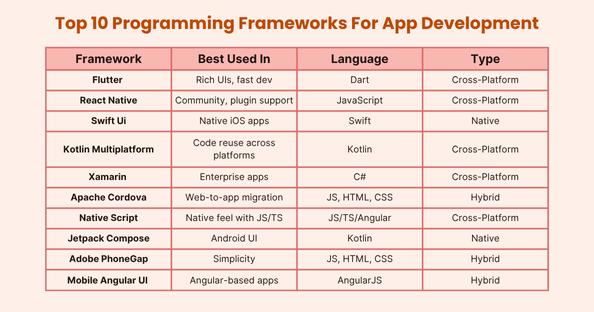
Now that you have a good idea about mobile app development frameworks, let’s see how you can ensure that you are choosing the best mobile application development framework.
How to Choose the Best Mobile Application Development Framework?
The selection of the best mobile app development platform depends on the alignment of the needs of your app and the strengths of the respective app development frameworks.
For example, Xamarin and Kotlin Multiplatform will be ideal for enterprise-grade project needs, while Flutter and React Native will be excellent choices for UI-rich, fast-development app requirements. There are a few key considerations that you must keep in mind while selecting the best mobile application development framework for your app.
- Performance and scope of scalability
- Developer support ecosystem
- Target platforms: Android, iOS, or both
- Budget and timeline
Choosing the best among the best mobile application development framework will require you to consider every speck of possibility, like trade-offs between performance, availability of resources, and the possibility of long-term maintenance.
Expert Tips to Maximize Framework Efficiency
Choosing the right framework is only half the achievement; the real milestone lies in efficiently using your chosen framework. Now that we have seen the top programming frameworks, it is of utmost importance to determine how to make the most out of these frameworks.
We recommend the following expert strategies to ensure maximum output from your framework, hence supporting efficient and scalable app development.
-
Deduce a Clear Development Roadmap
Clearly define your core features, tech stack, and user journey before starting your development process. This will help you make the most out of your development framework.
-
Leverage Your Reusable Components
You should try to leverage modular and reusable components to accelerate development, especially if you are choosing frameworks like React Native, Flutter, and Xamarin.
-
Integrate CI/CD Pipelines
Automate your testing and deployment process using continuous integration tools, as this can help reduce manual errors and accelerate your time-to-market.
-
Optimize for Performance Early
Prioritize streamlining the coding process and avoid relying on third-party plugins. Also, check your native features for compatibility for smooth performance.
Key Takeaways
- Mobile application development frameworks are becoming more diverse, versatile, and multifunctional.
- Cross-platform mobile app development frameworks allow faster development, hence reducing time to market, and allow a wider target audience.
- You should choose your framework based on the needs of your project and alignment with the strengths of the respective framework you are considering.
- Your selected mobile app development framework can impact the success trajectory of your digital product.
Conclusion
We understand that with so many available options, it gets difficult to choose the best mobile app development platform. This blog about the top 10 programming frameworks for app development in 2025 equips you with the information needed to make the right choice.
Each of these above-mentioned app development frameworks, from Flutter to Jetpack Compose, has unique strengths areas can help turn your app idea into a real-world solution. If you are looking to build your next app, choosing the right mobile app development framework and essential app development tools can help you get off to a strong start and lay a foundation for the long-term success of your business.