 iOS
iOS Android
 React Native
 Unity
Unity Flutter
 Ionic
Ionic IOT
IOT OTT
OTT Wearable
 Angular
 Python
 Vue.js
 Node.js
 PHP
PHP Laravel
 .Net
.Net WordPress
 Shopify
 Drupal
 Magento
 Social Media Marketing
 PPC Expert
 Content Writers
 GEO
GEO
 Virtual Assistants
 IT Support
 Customer Support
 Order Processing
 Contract Reviewers
 Logistics Coordinator
 eCommerce Solutions
 Bookkeeping
 Tax Preparation
 AR/AP Specialists
 Automation Testing
 Manual Testing
 AI Developer
 ML Developer
 RPA Developer
 UI/UX Designer
 Graphic Design
 Animation
 3D CAD
Mobile app security is not just limited to being a technical concern. Imagine spending thousands or millions on a mobile application just to see it all wrecked within a few months after the launch. A hacker, unknown, exploits a small vulnerability in your app’s code, and within a few hours, all your data is gone. This is not a ‘technical glitch’. It will cost you your customers’ trust, the confidence of your investors, your brand identity, and a lot more.
The United States has witnessed a surge in mobile security incidents by 60% in the last two years, and these attacks have been very sophisticated and unfamiliar. Regulatory bodies have responded with stricter enforcement under frameworks like HIPAA, CCPA, and PCI DSS, putting even more pressure on organizations to proactively look into their mobile apps and security. Decision makers are concerned with mobile application security solutions and demand that it be a primary part of mobile app development.
But, as a leader, how would you know if your security strategies are actually working?
That’s where mobile application security metrics come into play. These metrics offer tangible, trackable indicators that reflect the health of your mobile security posture. These metrics measure the effectiveness of mobile application security testing, track compliance readiness, and even identity risks introduced by third-party SDKs (to name a few).
This nightmare of a mobile app security breach can dawn upon the best of us, unless you know how to be cautious about the same.
Therefore, this blog outlines the top mobile app security metrics to look out for in 2025, curated specifically for leaders at the helm of digital innovation.
Mobile App Security Demands Executive Oversight in 2025
Security is a strategic imperative that directly impacts business performance. In 2025, mobile app security is firmly on the radar of CEOs, CTOs, and COOs. We have understood that the consequences of neglecting it extend far beyond data breaches.
For CEOs, the stakes are especially high. A mobile breach can result in millions in damages, from regulatory fines under frameworks like CCPA and HIPAA, to class-action lawsuits and reputational fallout that can’t be patched with software updates. The financial risk and loss of goodwill often far exceed the costs of proactive mobile application security investments.
Leaders in the tech department, especially the CTO’s are always grappling with a complex ecosystem, and maintaining visibility and control can become very difficult, especially with constantly evolving malware, and rising dependencies on third-party SDKs. They are entrusted with the responsibility of embedding mobile app security testing in agile SDLCs, managing zero-day vulnerabilities, and they have to make sure of the quick and safe deployment. All of this must happen without compromising on innovation.
If you think only the executives and tech heads are supposed to be worried about mobile app security, you must be understanding this the wrong way. Mobile application security is not just limited to a few titles. Even the operational heads, the COOs, must anticipate the challenges and the operational consequences of a security breach. A compromised mobile app can easily disrupt business continuity, expose internal systems, and affect employees, especially in BYOD (Bring Your Own Device) environments. Mobile app development costs are budgeted with precision, and a compromised mobile application security can force unplanned resource reallocation and emergency patch cycles, disrupting both budgets and timelines.
The bottom line is that mobile apps and security are now inseparable, and overlooking this relationship is a liability. The regulatory bodies of the USA are intensifying enforcement, consumers are demanding transparency, and boardrooms are expecting measurable risk mitigation strategies.
That’s why leadership teams must move beyond reactive measures and adopt a metrics-driven approach to security, one that ties technical safeguards to business continuity, regulatory compliance, and stakeholder confidence.
Top 10 Mobile App Security Metrics to Track in 2025
The executives must align mobile application strategy with measurable, data-backed security KPIs. These mobile app security metrics offer the visibility necessary to proactively identify threats, meet compliance, and protect business continuity.
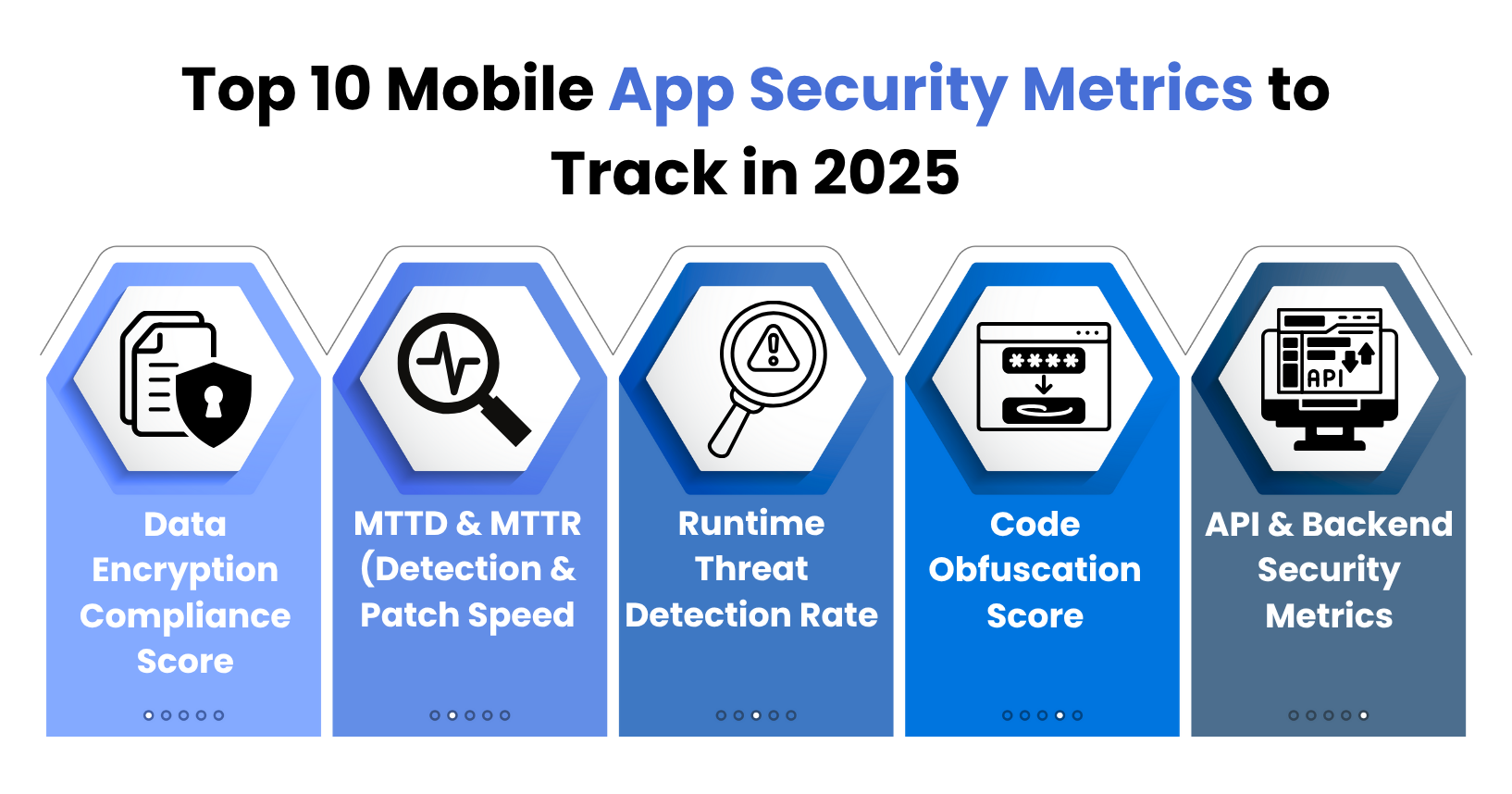
1. Data Encryption Compliance Score
What it measures:
This mobile application security solution keeps a check on the strength, scope, and implementation of encryption protocols used to secure sensitive data within a mobile app. It covers encryption in transit (e.g., TLS 1.3) and at rest (e.g., AES-256), key storage mechanisms (hardware-backed keystores), and adherence to compliance standards like FIPS 140-2 or NIST 800-57.
Why it matters:
Data breaches involving unencrypted personal or financial information can result in regulatory violations under laws like HIPAA, CCPA, or PCI DSS, particularly in healthcare, fintech, and eCommerce apps. More importantly, it erodes customer trust and leads to long-term reputational harm.
Executive perspective:
Leaders are concerned about this, as this score reflects the foundational integrity of the architecture of mobile app security. Data encryption compliance score assures that sensitive user data is being handled with due diligence. Having strong encryption is a mitigation strategy. Modern mobile application security testing tools can flag outdated ciphers, weak key lengths, and improperly secured transmission channels, giving leadership quantifiable insight into encryption hygiene.
2. Vulnerability Detection & Patch Velocity (MTTD & MTTR)
What it measures:
This mobile application security metric pair measures two things:
- Mean Time to Detect (MTTD): How fast mobile app security teams identify vulnerabilities or breaches?
- Mean Time to Respond/Remediate (MTTR): How quickly are fixes applied and deployed to production?
Why it matters:
The longer vulnerabilities remain unpatched, the higher the risk of exploitation. Cybercriminals often capitalize on known weaknesses within days of discovery. A slow process to patch up the weak ends can expose the business to data leaks, compliance penalties, and operational disruptions.
Executive perspective:
MTTD/MTTR mobile app security metrics provide a tangible benchmark of DevSecOps agility. The numbers generated after mobile app security testing reflect the efficiency of security response plans and how resilient the app lifecycle is under pressure. In regulated industries, short MTTR windows are critical to maintaining mobile app security compliance. Monitoring these metrics also helps prioritize investments in automation tools, code scanning platforms, and in-house or outsourced security teams.
3. Runtime Threat Detection Rate
What it measures:
This metric captures how effectively your app detects and responds to real-time threats once it’s installed on user devices. It includes detection of:
- Jailbroken or rooted devices
- Dynamic instrumentation tools (e.g., Frida, Xposed)
- Runtime injection attempts, API hooking, and SSL bypass attempts
Why it matters:
Pre-release mobile app security testing isn’t enough. Today’s attacks often happen post-deployment, especially in environments where users bring their own devices (BYOD). Malicious actors exploit runtime vulnerabilities to hijack sessions, extract tokens, or manipulate in-app logic.
>> Learn about essential post-launch KPIs to monitor your app’s performance and security effectively.
Executive perspective:
COOs are particular about a high runtime detection rate that ensures operational continuity, even when endpoint security is compromised. CTOs rely on this data to justify investments in advanced mobile application security solutions and those capable of self-defense. Implementing runtime application self-protection and runtime monitoring is becoming a key differentiator for emerging mobile application security companies in 2025.
4. Code Obfuscation & Reverse Engineering Resistance Score
What it measures:
This mobile app security solution assesses how difficult it is for attackers to decompile or reverse-engineer the mobile app’s source code. It evaluates the effectiveness of obfuscation techniques, string encryption, control flow randomization, and binary hardening.
Why it matters:
Weak obfuscation makes intellectual property (IP) very vulnerable to attackers and opens the door for them to inject malware, steal business logic, or publish fake versions of your app. It’s a major concern in industries like dating, healthcare, and fintech, where secure logic flow is critical.
Executive perspective:
Tech leaders need this score to protect proprietary algorithms, APIs, and internal SDKs while conducting mobile app security testing. CEOs benefit from the competitive edge that secured IP provides, particularly in innovation-heavy apps. Mobile application security testing tools like DexGuard, ProGuard, and Allatori can automate and monitor code hardening. Integrating these mobile application security solutions into the build pipeline shows a mature, proactive approach to mobile application security.
>> Compare Flutter and React Native to determine which framework offers better security features for your app development needs.
5. API and Backend Security Metrics
What it measures:
This mobile app security metric tracks the integrity, authentication, and access behavior of the APIs your app consumes or exposes. It includes:
- Number of failed API authentications
- Instances of insecure endpoints
- Rate limiting and token misuse patterns
- Exposure to OWASP M1 (Broken Object-Level Authorization)
Why it matters:
APIs are central to mobile app functionality, and they’re a frequent attack vector. If a mobile application has poor API security can lead to massive data leaks or unauthorized transactions. Weak and vulnerable endpoints are a clear violation of CCPA and PCI DSS if personal or financial data is involved in mobile apps and security.
Executive perspective:
For CTOs, API metrics act as a real-time risk monitor for the backend infrastructure. COOs should view these as an operational safeguard, particularly in apps handling sensitive workflows. If you want to ensure mobile app security, you must make sure to do continuous API testing, token validation, and OAuth2 compliance, combined with an observability tool.
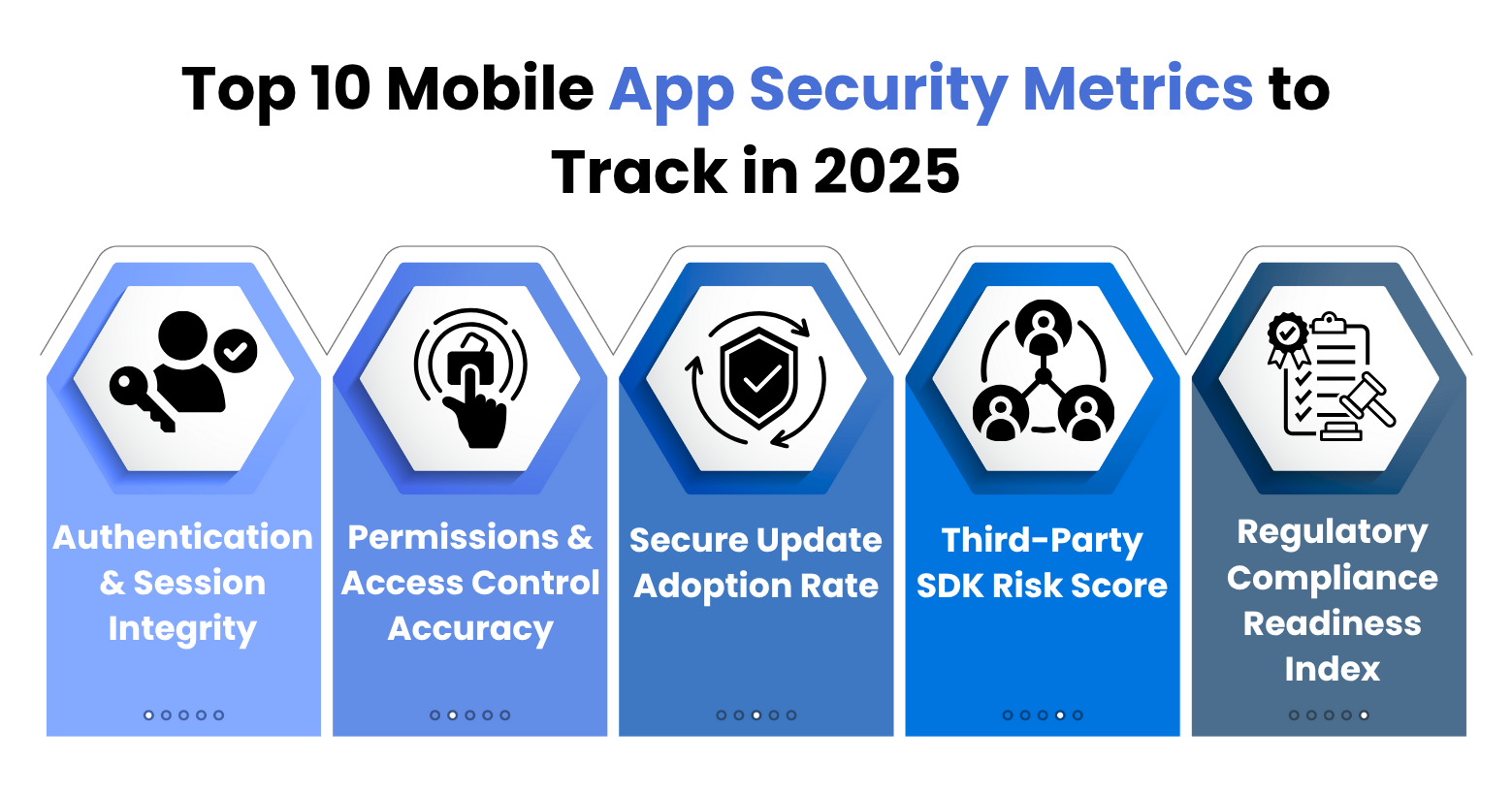
6. Authentication & Session Integrity Score
What it measures:
This mobile application security metric evaluates the strength and security of your app’s authentication mechanisms and session management protocols. It includes:
- Multi-factor authentication (MFA) adoption rates
- Session timeout durations
- Token invalidation processes
- Resistance to session hijacking and replay attacks
Why it matters:
Compromised user credentials are still a leading cause of mobile data breaches. If you don’t have strong authentication policies, attackers can bypass login flows, impersonate users, and exploit persistent sessions, especially in apps that store financial, personal, or healthcare data.
Executive perspective:
CTOs, via this score, analyse how well the app protects user identity and data integrity. COOs gain visibility into how session policies impact usability vs. security. From a CEO’s point of view, weak authentication can quickly lead to public fallout, customer churn, and non-compliance with laws like HIPAA and CCPA. Investing in biometric logins, adaptive authentication, and encrypted token storage helps reinforce both customer trust and operational resilience.
7. Permissions & Access Control Accuracy
What it measures:
This metric analyzes the types of permissions requested by the app (e.g., camera, location, contacts) and whether they are justified by actual app functionality. It also measures implementation of role-based access control (RBAC) and adherence to the principle of least privilege.
Why it matters:
Every single application on your mobile phone will request various permissions and access as soon as you open it. It’s common, but one must do it ethically. Over-permissioned apps raise red flags for users, app stores, and regulators. It is a major mobile app security concern.
Executive perspective:
CEOs and COOs must ensure that mobile teams respect user privacy, not just to maintain trust, but to comply with user consent laws like CCPA and GDPR, while conducting mobile app security testing. It is also a health check for CTOs on whether the access controls have been coded with precision. Security-conscious users in 2025 are highly aware of permission abuse, and apps that respect boundaries are more likely to retain long-term trust.
8. Secure Update Adoption Rate
What it measures:
This mobile app security testing metric tracks how quickly users install new versions of the app containing security patches or compliance upgrades. It includes:
- Time to update adoption across the user base
- Percentage of users still running insecure versions
- Frequency of critical patch rollouts
Why it matters:
No matter how fast your team deploys a fix, it’s only effective once users install it. A large portion of users on outdated app versions create a vulnerable footprint that attackers can exploit, especially if the patch addresses a known CVE (Common Vulnerability and Exposure).
Executive perspective:
COOs need to monitor and update adoption to evaluate whether release and communication strategies are effective. CTOs should integrate updated performance with incident response dashboards to ensure complete closure of vulnerability loops. This metric is essential for holistic mobile app security management.
9. Third-Party SDK Risk Score
What it measures:
This mobile application security testing metric evaluates the security risk associated with third-party SDKs integrated into the mobile app. It includes:
- Number of SDKs used and their security audit history
- Known vulnerabilities (CVEs) associated with SDK versions
- Behavioral anomalies like data leakage or hidden tracking
Why it matters:
SDKs are often added for functionality– ads, analytics, payments–but they’re also a leading source of unintentional exposure. Many past breaches have occurred because a third-party code collected or transmitted sensitive data without proper consent or encryption.
Executive perspective:
This score is about supply chain visibility for the CTOs. It’s critical to use mobile app security testing tools to scan SDK behaviors and version histories. COOs and CEOs must make sure that vendor dependencies are vetted and monitored continuously, not just at release, for better mobile apps and security. In 2025, mature enterprises treat SDK governance as seriously as internal code security.
>> Explore the top app development frameworks for 2025 to ensure your mobile applications are built on secure and efficient platforms
10. Regulatory Compliance Readiness Index
What it measures:
This index assesses how well the mobile application aligns with relevant industry and regional compliance requirements. It covers:
- HIPAA compliance for healthcare apps
- CCPA and CPRA readiness for user data privacy
- PCI DSS conformance for payment handling
- SOC 2 and NIST adherence for enterprise SaaS platforms
Why it matters:
In the US, regulatory violations can lead to massive fines, lawsuits, and brand damage. Mobile apps and security must demonstrate compliance not just in audits, but continuously through well-documented security processes and testing routines.
Executive perspective:
Regulatory Compliance Readiness Index is what the CEO and the legal teams of a company rely on to avoid legal risks. CTOs generally make sure that compliance checks are automated and included in the development pipeline. A strong index supports business expansion by proving to the partners and clients that the mobile app and security are a safe bet.
Emerging Trends Reshaping Mobile App Security in 2025
Cyber criminals are evolving and truly coming up with new ways to become a threat. So, it’s essential that your business, especially mobile app and security, is air-tight and regularly monitored. There are many ongoing/ emerging trends that change how enterprises can approach mobile app security.
1. AI-Powered Threat Detection & Anomaly Monitoring
AI is being embedded into mobile app security testing tools to detect possible threats in real time before the business suffers losses. Machine learning (ML) algorithms can analyse millions of events, behaviours, and data flows to flag abnormal patterns or any malpractice during the mobile app security testing.
Leading security solutions are using artificial intelligence to identify credential stuffing, bot attacks, reverse engineering attempts, and unauthorized API access. For a business, this means a faster response, fewer false positives, and less reliance on manual monitoring.
2. Zero Trust Architecture Goes Mobile
Rather than assuming apps on corporate or managed devices are secure, Zero Trust Architecture requires constant authentication, real-time context analysis, and device posture validation.
CTOs and COOs are increasingly implementing Zero Trust frameworks in mobile CI/CD pipelines, particularly for apps handling sensitive enterprise data.
You can expect a surge in mobile application security testing tools and platforms that offer continuous authentication and dynamic policy enforcement.
3. Regulatory Scrutiny on SDKs & Data Sharing
Regulators are focusing not just on the app itself, but the invisible third-party code running inside it. SDKs used for analytics, ads, payments, or push notifications are now being examined for data handling practices, particularly under CCPA, CPRA, and forthcoming federal privacy laws in the US.
As a result, there’s a growing demand for SDK risk-scoring engines and open-source alternatives. Enterprises are also setting stricter vendor onboarding rules to avoid blind spots in their mobile application security solutions.
4. Development Stage: Integration of Mobile App Security Testing Tools
Security is shifting, moving from final-stage testing to being embedded earlier in the development lifecycle. Teams are integrating static analysis tools, secrets scanning, and compliance testing directly into their IDEs and CI/CD pipelines.
This trend empowers leaders to catch vulnerabilities during development rather than post-production. It also helps the operations heads to manage project risk more proactively. In fact, mobile teams embracing shift-left practices have reduced their MTTD and MTTR by over 40% compared to those using legacy workflows.
5. User Trust & Privacy as Competitive Differentiators
Security is part of the user experience. Privacy dashboards, clear permission prompts, and secure-by-design interfaces are now key to user retention.
This shift is aligned with the brand value. Demonstrating a transparent, ethical approach to mobile app security can drive loyalty, improve app store ratings, and become a USP in regulated sectors like health, finance, and education. Consumers increasingly favor apps that treat privacy not as a legal obligation, but as a core feature.
Understand how strategic micro-interactions can enhance user trust and contribute to your app’s security posture.

How to Start Tracking These Mobile App Security Metrics Effectively?
Understanding the right mobile app security metrics is only half the battle; executing them consistently across your mobile infrastructure is where real risk mitigation begins. Decision makers who are burdened with resource constraints, compliance pressure, and market demands, here’s how to integrate these metrics into your mobile strategy without compromising speed or scalability.

1. Embed Security into the Development Lifecycle (Shift Left)
Security must be built into the DNA of your mobile application and not checked on at the end. Begin by integrating static mobile app security testing and dynamic analysis mobile application security testing tools into your CI/CD pipeline. This allows you to identify vulnerabilities early, measure your MTTD and MTTR, and prevent security debt from accumulating.
Pro Tip: Feel free to adopt platforms that support automated compliance checks and offer real-time dashboards for metrics like patch velocity, API security, and permission analysis.
2. Use a Centralized Dashboard for Security KPIs
Just as marketing and sales teams rely on KPIs to drive performance, tech leaders must use a unified dashboard to monitor security health. Track critical metrics such as encryption compliance, runtime threat detection, update adoption rates, and SDK risk scores.
These insights should be accessible across engineering, operations, and compliance teams. The goal is visibility and accountability, not just among developers, but across the executive suite.
3. Audit Third-Party Dependencies Regularly
Treat every third-party SDK, library, or plugin as a potential attack. Maintain an updated inventory, monitor for newly disclosed vulnerabilities (CVEs), and measure their security impact over time. Tools like MobSF, ZAP, and Checkmarx can help assess SDK behaviors and flag high-risk components.
Pro tip for CTOs: Focus on automating the SDK audits during staging builds and pre-release testing to prevent regressions.
4. Align Metrics with US Compliance Standards
Many organizations track security metrics but fail to tie them back to regulatory frameworks. Map your metrics to compliance requirements under HIPAA, CCPA, PCI DSS, and even SOC 2 Type II, particularly if you handle healthcare, payments, or PII.
By doing so, leaders can build stronger audit trails, demonstrate accountability, and prepare for regulatory scrutiny without last-minute chaos.
5. Invest in the Right Development Partners
If your in-house team lacks the security depth or bandwidth to operationalize these mobile app security metrics, consider partnering with a mobile app development company that integrates security at every phase, from ideation to release.
There are many emerging mobile application security companies that offer mobile app development with embedded mobile app security practices, proactive testing, and full visibility into the KPIs that matter.
Conclusion
To conclude, mobile app security in 2025 is more than a technical checklist; it’s a business-critical priority. CEOs, CTOs, and COOs should always be on the lookout for the changing mobile app security metrics that provide the clarity and control needed to protect users, preserve trust, and stay compliant in an increasingly complex digital ecosystem. Everything from encryption and authentication to runtime protection and SDK governance, alerts you about your app’s resilience and your organization’s readiness.
Tracking these KPIs isn’t just about preventing breaches; it’s about leading with confidence, backed by data.
Build Secure Mobile Apps with Resourcifi
At Resourcifi, we don’t just build mobile apps, we engineer them with security at the core. With over a decade of experience in mobile app development, our team integrates security best practices, compliance alignment, and real-time testing into every stage of delivery.
We ensure your business stays protected, scalable, and ahead of the curve.