
 iOS
iOS Android
 React Native
 Unity
Unity Flutter
 Ionic
Ionic IOT
IOT OTT
OTT Wearable
 Angular
 Python
 Vue.js
 Node.js
 PHP
PHP Laravel
 .Net
.Net WordPress
 Shopify
 Drupal
 Magento
 Social Media Marketing
 PPC Expert
 Content Writers
 GEO
GEO
 Virtual Assistants
 IT Support
 Customer Support
 Order Processing
 Contract Reviewers
 Logistics Coordinator
 eCommerce Solutions
 Bookkeeping
 Tax Preparation
 AR/AP Specialists
 Automation Testing
 Manual Testing
 AI Developer
 ML Developer
 RPA Developer
 UI/UX Designer
 Graphic Design
 Animation
 3D CAD
Staying steady and relevant in the field of mobile apps today requires a strategic approach well beyond the initial processes of development and launch. Your understanding of the efficiency of your mobile app delivering the business objective post-launch is of utmost importance.
This creates an absolute necessity of laying strong emphasis on keeping a track of mobile app KPIs, i.e., key performance indicators, that provide insights on parameters like user-retention, monetization and and the overall app health post-launch.
In this blog, we will delve deep into the critical mobile app KPIs that demand your attention during post post-launch phase, offering a comprehensive framework for long-term growth and profitability.
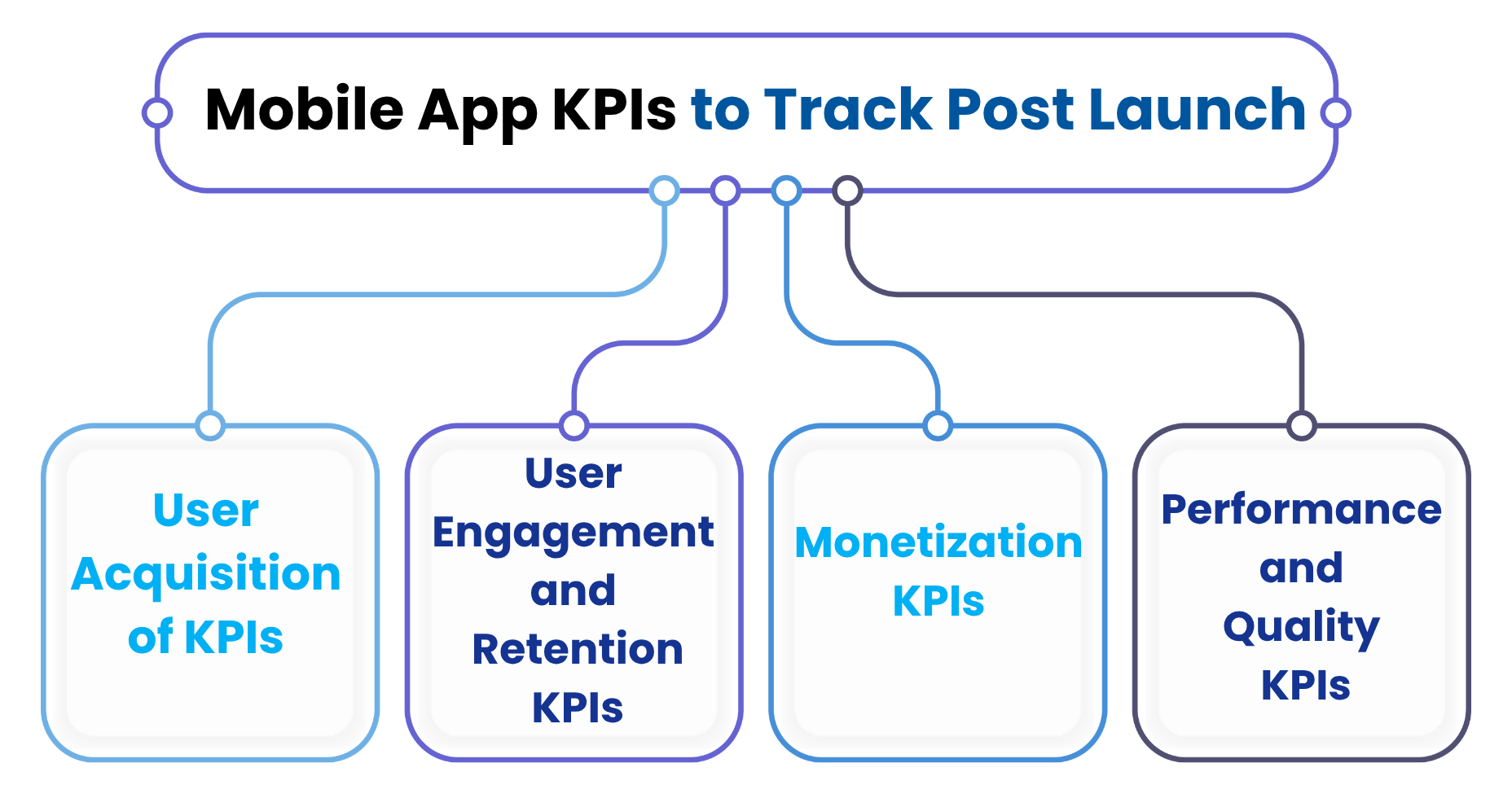
User Acquisition KPIs
The initial success of a mobile app’s lifecycle is often determined by its ability to attract and convert new users. Several mobile app KPIs highlight the effectiveness of acquisition strategies and the initial user experience-
-
Installs and downloads
Being one of the basic metrics, it provides crucial differentiation between raw downloads and active installs, laying the foundational understanding of reach.
-
Cost per Install
This metric sheds light on the cost associated with getting a single new install. A lower CPI highlights a more efficient marketing spend. You can analyze CPIs across different channels, like social media and search ads, to optimize your budget allocation.
-
Return on Investment(ROI)
This metric goes well beyond CPI to understand the overall financial returns. It is calculated by comparing the revenue post-launch generated by users against the cost of acquiring them. It can be a critical indicator of your profits.
-
App Store Rankings
It will be right to say that the visibility of your app post launch in the app store is one of the most important mobile app KPIs, as it directly correlates to organic downloads. It provides an overall insight into the effectiveness of the App Store Optimization strategies.
-
First Time User Experience Completion Rate
It is one of the mobile app KPIs that tracks the percentage of new users who finish their initial onboarding steps, i.e, the first critical interactions within the app. A low FTUE completion rate can indicate usability issues or a lack of clarity in the onboarding flow, leading to higher initial churn rates.
-
Conversion Rates
This is one of the mobile app KPIs that checks the effectiveness of the advertising campaigns by measuring the percentage of users who install an app after seeing an ad.
It is a direct indicator of your advertisement’s creative effectiveness and targeting precision.
These acquisition-focused mobile app KPIs lay the groundwork for understanding the initial traction of your application. However, attracting customers is only the first stage; retaining them for a longer time is where the success of your app resides.
You can also hire developers from India, who will not only help you with the app development process but will also help you to monitor all these metrics.
User Engagement and Retention KPIs
Once the initial stage of user signups has been completed, the focus shifts to keeping them engaged and ensuring that they stick to the app for a longer period. These mobile app KPIs are vital for the long-term success of your app and directly influence the overall mobile app performance KPIs.
-
Daily, Weekly, and Monthly Active Users
They are the foundational metrics for measuring the active user base over different timeframes.
Analyzing trends of DAU, MAU, and WAU can highlight the insights of app health and growth. They can precisely provide data on how frequently users return to the app.
-
Session Length
It is the average duration of a user session. Longer session lengths directly indicate deeper engagement and satisfaction levels with the app’s content or features.
-
Session per user
The average number of times a user opens the app within a given timeframe is one of the most important mobile app KPIs when it comes to post-launch support. A higher number of sessions usually indicates greater utility and perceived value.
-
Retention Rates
This critical mobile app KPI measures the percentage of users who visit the app after a specific amount of time. High retention rates post launch are directly proportional to compelling user experience and strong product-to-market fit.
-
Churn Rates
The opposite of retention rates, it represents the percentage of users who stop using the app within a given timeframe. Higher churn rates post-launch can be indicative of some underlying issue and are a call for robust post-launch support.
-
Feature Usage
Keeping track of which of your app features are well-received and which are neglected can provide valuable insight for post-launch support and app maintenance, as this mobile app performance KPI is a guide for feature evolution.
-
User Flow/ Path Analysis
Visualizing the path users take within the app helps identify common navigation patterns, drop-off points, and areas of friction. This mobile app performance KPIs can uncover usability issues that often hamper engagement.
-
Push Notification Opt-in Rate and Engagement Rate
For apps utilizing push notifications, measuring the percentage of users who opt in and subsequently engage with these notifications is one of the most crucial mobile app KPIs. It indicates the effectiveness of communication strategies and the value of alerts.
-
Crash-Free Sessions
This is a direct indicator of app stability and quality, influencing the overall mobile app performance KPIs, as a high crash-free rate is fundamental for a positive user experience.
These engagement and user retention mobile app KPIs are the foundation rock of a thriving application. They provide a clear insight into how well the app is performing and what are the areas in which improvement and post-launch support is needed.
Monetization KPIs
The ultimate goal of your digital product is to generate profit and add revenue to the business. The following mobile app KPIs are essential for understanding the financial aspects and performance of the app-
-
Average Revenue Per User(ARPU)
These mobile app KPIs help to calculate for each active user over a defined timeframe. It is also a key performance indicator of monetization efficiency.
-
Lifetime Value (LTV)
LTV is a mobile app performance metric that helps you to gain an estimate of how much revenue you can generate from a user throughout their relationship with the app. Understanding LTV is crucial for optimizing marketing expenses and user acquisition strategies.
-
Conversion Rate from Free to Paid
For freemium models, this tracks the percentage of free users who convert to a paid subscription or make in-app purchases.
-
In-App Purchase (IAP) Revenue
The total revenue collected from in-app purchases is one of the most crucial KPIs. Analyzing IAP revenue by category, item, and user segment can highlight profitable areas and inform pricing strategies.
-
Ad Revenue
For ad-supported apps, this is one of the most essential mobile app performance metrics to track, as it helps measure the revenue generated from in-app purchases.
-
Subscription Revenue
For the subscription-based apps, this is a mobile app performance KPI, as it tracks the recurring revenue from active subscriptions.
-
Payment Success Rates
The percentage of successful transactions out of all the attempted payments. A low success rate could be indicative of potential issues with the payment gateway or challenges during the purchase process.
Monetization mobile app KPIs are directly linked to the financial viability of the application, providing you with a clear picture of profitability and growth potential.

Performance And Quality KPIs
There is one aspect that lies beyond the user aspect and monetary benefits, i.e., the underlying technical performance and quality of the app, which significantly impact the user experience and, in turn, all the other mobile app KPIs.
These mobile app KPIs are often overseen by the technical teams, but are of extreme importance for executive awareness.
-
App Load Time
It is the time your app takes to launch and then become fully functional. Slow load times can lead to frustration and early elevated churn rates. Optimizing load time is paramount for initial UX.
-
API Response Time
It is one of the mobile app performance KPIs that checks the time your app takes to communicate with the backend server. Slow API response times can indicate a sluggish user experience.
-
Security Vulnerabilities
Regular security testing is an essential aspect of mobile app performance KPIs. The number and severity of identified vulnerabilities are critical mobile app KPIs for risk management.
-
Server Uptime/Downtime
It is the percentage of time the app’s backend servers are operational. Downtime directly impacts app accessibility and user satisfaction. This is a critical mobile app performance KPI.
-
Bug Reports/Tickets
The number of bug reports is directly related to the effectiveness and stability of the app. Hence, it is an extremely important mobile app performance KPI.
-
Uptime of Integrated Third-Party Services
If your app relies on external APIs or services, monitoring their uptime and performance is crucial. This extends to mobile app maintenance services providers, ensuring their service reliability.
These performance and quality mobile app KPIs underpin all the other metrics. A technically efficient application is the foundation for positive user experiences and sustained growth.
Neglecting these can lead to significant issues requiring extensive mobile app maintenance services.
The Role of Analytics and Iteration
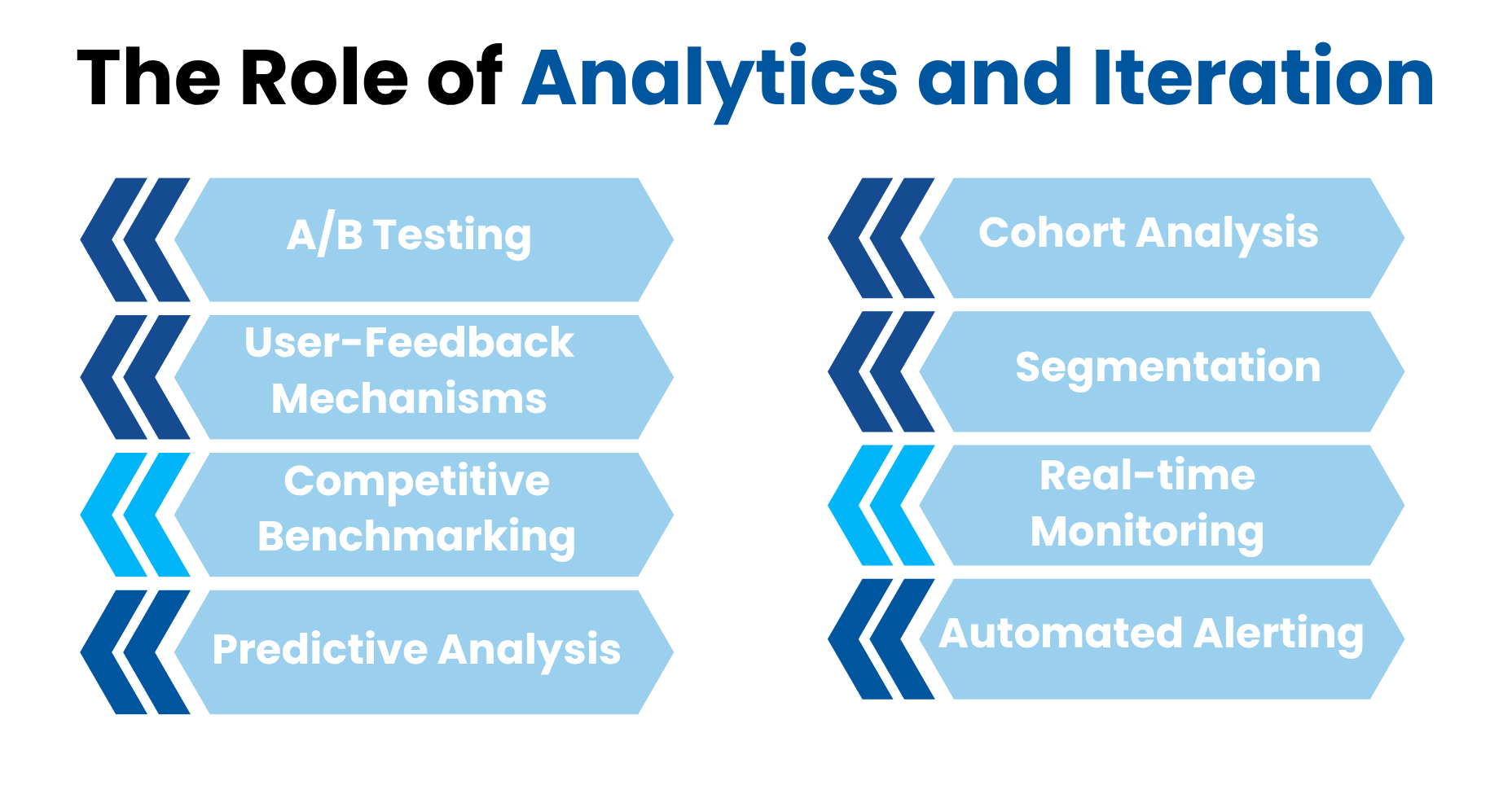
The post-launch support phase is inherently iterative. The insights gained from mobile app KPIs should fuel continuous improvement cycles, which involve-
- A/B Testing
- User-Feedback Mechanisms
- Competitive Benchmarking
- Predictive Analysis
- Cohort Analysis
- Segmentation(breakdown of mobile app KPIs by user segments like demography and usage patterns)
- Real-time Monitoring
- Automated Alerting
All these are significant components of proactive post-launch support.
The commitment to continuous analysis and iteration, supported by comprehensive mobile app maintenance services, is what truly differentiates a successful app in the long run.
Conclusion
Mastering the field of mobile app KPIs post-launch is not merely a technical exercise but a strategic decision. By meticulously tracking and analyzing key metrics across user acquisition, engagement, monetization, and performance, organizations can gain an unparalleled understanding of their app’s health and trajectory. By partnering with an app development company that provides mobile app maintenance services, you can ensure all the above-mentioned mobile app performance KPIs are well taken care of.