
 iOS
iOS Android
 React Native
 Unity
Unity Flutter
 Ionic
Ionic IOT
IOT OTT
OTT Wearable
 Angular
 Python
 Vue.js
 Node.js
 PHP
PHP Laravel
 .Net
.Net WordPress
 Shopify
 Drupal
 Magento
 Social Media Marketing
 PPC Expert
 Content Writers
 GEO
GEO
 Virtual Assistants
 IT Support
 Customer Support
 Order Processing
 Contract Reviewers
 Logistics Coordinator
 eCommerce Solutions
 Bookkeeping
 Tax Preparation
 AR/AP Specialists
 Automation Testing
 Manual Testing
 AI Developer
 ML Developer
 RPA Developer
 UI/UX Designer
 Graphic Design
 Animation
 3D CAD
Are you eyeing the booming mobile app market, projected to hit a staggering $600 billion by 2030? If yes, you’ve probably found yourself wondering how to develop a mobile app that truly stands out. What’s the average cost of mobile app development today? What’s the realistic timeline for mobile app development? And most importantly, what factors influence the mobile app development timeline in the first place?
From large-scale enterprises to lean, bootstrapped startups, every business is exploring mobile app development as a way to stay connected with customers 24/7, deliver real-time experiences, and open up new revenue streams. But the journey isn’t as simple as having an idea—it involves strategic planning, choosing the right tech stack, and understanding the true cost to develop a mobile app.
The reality is, building an app, launching it successfully, and keeping it relevant in a competitive market requires more than just coding skills—it demands clear goals, the right resources, and a strong grasp of the financial and time commitments involved.
That’s why in this comprehensive guide, we’ll walk you through every stage of the process while helping you budget smarter, plan your timelines, and avoid common pitfalls.
So, whether you’re here to learn how to develop mobile app solutions, figure out the average cost of mobile app development, or decode what factors influence the mobile app development timeline, you’re in the right place.
Let’s dive in!
Understanding the Mobile App Scenario
A decade ago, mobile apps for any business were a luxury, but now they have evolved into a necessity, as they provide you with the much-needed credibility and ease of access to your brand.
There are some other essential benefits of learning how to develop mobile apps and implementing them, such as:
- It strengthens and promotes user engagement.
- It facilitates real-time communication.
- It establishes consumer loyalty through customized and tailored services.
The benefits of learning how to develop mobile app are widespread and practically infinite. Mastering the art of mobile app development and aligning it with your customer expectations is an important business imperative. If you are aiming to boost customer service or exploring your options to generate various revenue streams, learning how to develop mobile app can be of utmost importance.
However, with the rising average cost of mobile app development, you will need a strategically laid-out plan to maximize your ROI with minimal investments.
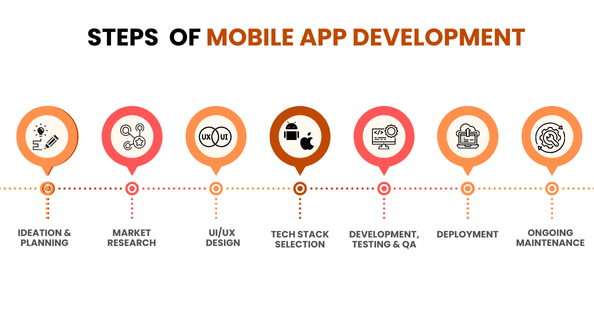
What are the Steps of Mobile App Development?
Ideation and Planning
The initial and one of the most important steps of how to develop mobile app is ideation and planning. It helps in clarifying your purpose or intent behind the app.
These are the questions you can ask to easily recognize the purpose of the app:
- What is the issue that it solves?
- Who is the target audience/ potential customers?
- What are the core features of the app, and which are cosmetic?
- Will this idea remain relevant in the future?
Answering these questions will clearly define your priority and expected features, which will help you gain an idea regarding your timeline for mobile app development.
Market Validation and Research
The initial stages of mobile app development are the perfect time for market research and validation.
You can do so by exploring other similar apps and reviewing the following aspects:
- Analyzing their features and gaps.
- Study reviews of similar apps to gain an understanding of the user’s pain points.
- Determine your unique value proposition.
Right alignment with the market can significantly impact the cost to develop a mobile app, as the evolution of features and determination of core features depend on the expectations of users.
UI/UX Design
The next step one needs to figure out to answer “how to develop a mobile app” is crafting UI/UX. You have to design wireframes, mockups, and clickable prototypes.
Make sure that the interface is user-focused, facilitates conversions, and represents the brand well.
Planning and designing the UI/UX is also extremely important as it is one of the crucial factors determining the average cost of mobile app development and also the expected timeline for mobile app development.
Selecting the Right Technological Framework
The next essential step is figuring out the right technological framework for development. You must determine if you want to build native apps in Swift or Kotlin, or hybrid apps in platforms like Flutter or React Native. Making the right tech choices is an integral part of estimating the timeline for mobile app development, as it highly impacts the same.
Development, Testing, and QA
Once you’ve finalized the right technological framework, it’s time to roll up your sleeves and dive into the development phase. This is where your app starts taking shape – coding the frontend for a seamless user interface, building the backend for robust functionality, creating APIs for smooth data exchange, integrating essential third-party tools, and embedding security measures right into the design.
With development complete, the focus shifts to Testing & Quality Assurance (QA), a stage that’s just as critical as writing the code itself. Here, you’ll run unit tests to ensure each component works as intended, perform manual testing for real-world scenarios, validate performance across different devices, and fix any bugs before your users ever encounter them.
Why is this step so important? Because rigorous QA directly translates into a smoother, more reliable user experience, helping your app launch strong and build trust from day one.
Deployment and Post-Launch Optimization
Once all bugs are fixed and your QA team gives the green signal, it’s time for deployment—publishing your app on platforms like Google Play and the Apple App Store. This stage isn’t just about going live; it also involves preparing compelling store listings, designing eye-catching icons, and creating marketing collateral to ensure your app grabs attention from day one.
But deployment is far from the finish line. The post-launch optimization phase is where the real work begins. Here, you’ll continuously monitor performance, analyze user feedback, and roll out updates that keep your app functional, competitive, and aligned with evolving user expectations.
These steps are not only essential for mastering how to develop mobile app solutions effectively, but they also significantly influence the average cost of mobile app development, making careful execution a must.
Tech Stacks Used for Mobile App Development
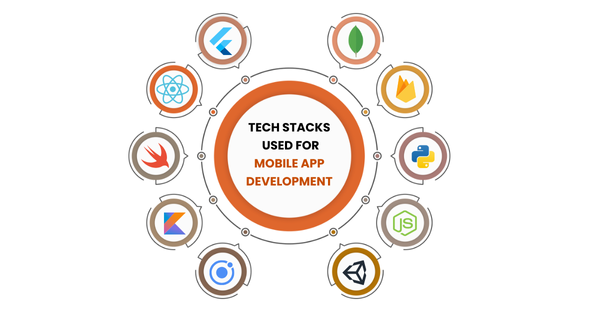
The tech stack you choose heavily determines the scalability, performance, and the required average cost of mobile app development. It is also the limiting factor when it comes to your ability to integrate with other systems and evolve the features over time.
For Frontend Development
There is a variety of trending programming languages and tech stacks available for frontend development of native and cross-platform apps, like-
Native apps
The most used tech stacks for the development of the frontend of native apps are Swift in the case of iOS app development and Kotlin for Android app development.
Collaborating with an iOS and an Android app development company can prove to be of significant help.
They do provide one-of-a-kind performance, but generally increase the timeline for mobile app development. Hence, the timeline for mobile app development must be planned accordingly when using these tech stacks.
Cross-Platform Apps
The most popular tech stacks for cross-platform apps are Flutter and React Native. Both of these platforms allow faster builds and a vast network of developers with shared codebases.
They are ideal for businesses that want a lower average cost of mobile app development and rapid build without compromising on quality.
In addition to being cost-effective, most of the Flutter and React Native app development companies also provide end-to-end assistance, creating a win-win situation for you.
Apart from these, Ionic is another very effective framework for cross-platform apps. And if you specifically want to focus on game apps, then Unity can be a very versatile option. Collaborating with an Ionic or Unity app development company can boost the development process significantly.
For Backend Development
Similarly, when the question of how to develop mobile app comes to identifying the backend technologies, the following are some of the popular tech stacks trending in the industry –
Node.js
It is lightweight and fast, and proves to be an excellent option for real-time apps.
Django (Python)
Django is well sought after for being secure and reliable; it performs exceptionally well for apps dealing with sensitive information and are data-heavy.
Ruby on Rails
It is an ideal choice amongst the trending tech stacks for rapid prototyping of MVPs.
Spring Boot (Java)
Spring Boot is the ideal choice for enterprise-level apps of enterprise level, as it can deal with extensive data.
For Databases
Firebase
It gets synced in real time and works best for chat or collaboration apps.
PostgreSQL/MySQL
They are one of the most popular choices for a Relational Database Management System for structural organizations.
Mongo DB
A NoSQL database that prioritizes flexibility and speed, perfect for handling large volumes of unstructured or semi-structured data.
Other than these for DevOps and CI/CD tools like Docker, Jenkins, and GitHub Actions prove to be extremely beneficial in streamlining the deployment process. Restful APIs and GraphQL ensure flexible integrations.
Apart from the mobile app development process, choosing the right tech stack heavily impacts the average cost of mobile app development. Hence, choosing a reliable mobile app development company can help you balance performance with cost.
What is the Average Cost of Mobile App Development?
To answer this question, we must start by asking, what are the main features of my app, what is the platform, tech stack, and framework I am going to use, and what is the goal of my app?
Once you find an answer to all these questions, estimating your possible average cost of mobile app development becomes easier.
Here are some of the estimated average costs of mobile app development-
- For a basic app with static content, the average cost goes around $15,000- $30,000.
- For a mid-level app, with an intuitive UI, strong database, API, and logic, the average cost of mobile app development can range from $30,000- $80,000.
- The cost to develop a mobile app of advanced capabilities, including complex features like real-time data analysis, payment integrations, and AI, can range from $80,000- $300,000.
Apart from these, some unattended factors that heavily impact the cost to develop a mobile app are design requirements, project management, testing and QA, and post-launch support.
You also need to keep an account of the estimation of cost across iOS and Android, as the average cost of mobile app development greatly varies across those platforms. Other than these, if you are using staff augmentation, outsourcing, or using an in-house team to develop a mobile app also impacts the cost to develop a mobile app.
You can always contact us at Resourcifi to gain further understanding of the cost estimates of developing a mobile app.

What is the Expected Timeline for Mobile App Development?
The timeline for mobile app development can vary from app to app due to different factors. However, here’s an average breakdown of the timeline for mobile app development-
- Planning & Research: 2-4 weeks
- Designing: 3-6 weeks
- Development of Frontend & Backend: 8-20+ weeks
- Testing & QA: 3-6 weeks
- Deployment & Post Launch: 1-2 weeks and onwards
However, if you are building an app with advanced features like geofencing, live chat, or immersive technologies like AR and VR. The timeline for mobile app development can extend.
Now that we have discussed a general timeline for mobile app development, you must be wondering what factors influence the mobile app development timeline.
The timeline for mobile app development depends on more than just code. The following are some of the major factors that affect the timeline for mobile app development.
App Complexity
If your app contains more screens, custom layouts, animations, and third-party tools, it is most definitely that it will extend the timeline for mobile app development.
Tech Stack
If you are building a native app, it generally takes a longer duration of time, and if you are building for cross-platform, it is faster.
Team Size
Team size heavily impacts the timeline for mobile app development; a larger team that is well coordinated shortens the timeline for mobile app development.
Feature Addition
Constantly adding new features that were not considered during the initial development plan can push back the timeline for mobile app development by many weeks.
Approval Cycles
Last-minute client reviews, requested changes, or app store compliance can cause a delay in the mobile app development project going live.
Having a clear understanding of what factors influence the mobile app development timeline allows you to prepare your stakeholders and resources and develop a well-strategized launch plan.
Now that we have seen initial aspects of how to develop a mobile app, up to the development stage, let’s understand why post-launch app maintenance is essential.
Why Post-Launch App Maintenance is Essential?
Most people think that the process of development ends after deployment, but the ongoing maintenance of the app and its post-launch KPIs are the most important to track and work on.
It is also one of the major drivers of the cost to develop a mobile app. It’s where your app’s long-term value is built upon.
The following are the major areas where post-launch app maintenance is essential-
Operating System & Device Updates
Mobile apps tend to evolve quickly, so if you don’t invest in regular operating system and device updates, there is a high chance that your mobile app will develop bugs and eventually become unusable.
Bug Fixes
Majorly bugs show up after launch. Hence, regular updates improve the overall functioning of the app by implementing the changes in alignment with user feedback, in turn increasing user retention and performance.
Feature Enhancements
If you want to navigate through the roadmap of mobile app development, then user feedback is the most important fuel. It helps to perform strategic analysis before releasing new features and refinements. This helps the app to remain relevant and afloat in the market.
Server Monitoring and Security
One of the most essential aspects of mobile app development is protecting user data and enhancing security. One of the best ways to ensure this is regular maintenance, which includes SSL updates, monitoring the API , and patching up the vulnerabilities.
Analytics- Driven Optimization
It is the best practice in mobile app maintenance to track the user retention and churn rates. This helps to perform detailed analysis and determine methods to improve onboarding, UX, and conversions.
If you are partnering with an experienced mobile app development company, then post-launch mobile app maintenance comes included with the proposal.
And it is something which should be a factor in your average cost of mobile app development, in order not to have any expensive reactive maintenance later.
What are Some of the Latest Trends in Mobile App Development?
If there is something that is evolving at an unmatched speed, it is mobile app technology. Staying relevant to the trends makes sure that you have an enhanced UX and increased user engagement. Some of the recent trends of mobile app development include-
AI-Powered Apps
AI-powered apps have a competitive edge as they provide features like predictive search to smart automation, hence boosting engagement.
5G Integration
The users today demand rapid delivery, and to facilitate this, integration of 5G is extremely useful as it strongly boosts performance and enables real-time immersive technology integration.
Super Apps
The rise of super apps has brought about a revolutionary change in the latest mobile app development trends. Such apps are widely praised and used for combining features of messaging, payments, sometimes streaming, etc, into a single ecosystem.
Voice and Gesture Control
Integrating Voice and gesture control in UX has consistently stayed on top of mobile app development trends. They are highly effective in making mobile apps more accessible and intuitive.
Edge Computing
Edge Computing comes with a plethora of assistance and benefits by enabling faster local processing. Apart from this, it is highly capable of providing better data privacy.
Green Tech
It is not hidden from you or anyone that the mobile technology or the tech space demands a lot of natural resource utilization; for instance, tonnes of water go into keeping the servers cool for even a single app. Hence, using green and energy-efficient tech is a user as well as a compliance requirement of contemporary times.
Adding these trends or taking care of them during mobile app development may raise your average cost of mobile app development in the initial stages, but brings the guarantee to offer longer-term increased ROI.
How to Choose the Right Mobile App Development Company?
After reading this blog on how to choose the right mobile app development company, one thing that must have become clear to you is that the right partnering mobile app development company can help you save money, cut down the development timeline or prevent it from extending it and build your reputation and brand loyalty over time.
But to gain all these benefits, one of the most important aspects is choosing the right mobile app development company.
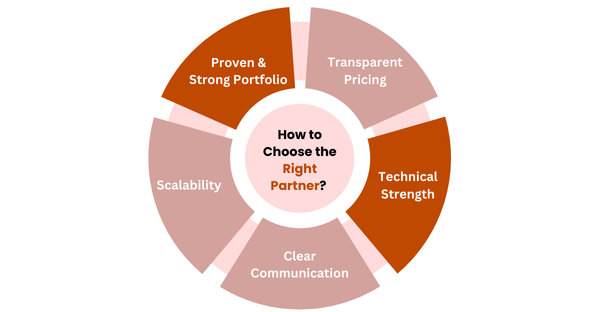
Here are some of the key considerations you should look out for when choosing your partner mobile app development company-
Proven and Strong Portfolio
Make sure to thoroughly go through the portfolio of the previous case studies and testimonials. This will not only give an idea of the kind of mobile app development projects they have worked on before, but also the user feedback received from their previous clients.
Transparent Pricing
Always choose a mobile app development company that has fixed rates against the benefits they provide, and is transparent on the breakdown of the mobile app development cost estimate from the initial stages.
Technical Strength
One of the most important criteria to look for while choosing a mobile app development partner is knowing if they are fluent in the tech stack you are expecting to develop your mobile app in. This will make sure that your app is powerfully built and is functionally flawless.
Scalability
Scalability of the app is one of the most essential but overlooked factors of mobile app development.
While answering the question, How to develop mobile app, you must also ask for an answer to how this app will scale and what the plan of action is for maintaining the performance and scalability of the app.
Always remember that a good mobile app development company will have strong scalability solutions.
Clear Communication
The right and most efficient mobile app development company will always ensure that it communicates clearly regarding every small detail of mobile app development.
It should be able to provide transparent communication regarding timelines, regular updates, and issue resolution.
Above all, it is worth taking note that the selection of the right mobile app development company isn’t just about checking its average cost of mobile app development or the above-mentioned points, but it is more about ensuring the company’s alignment with your app’s vision.
Final Thoughts
We hope this comprehensive guide on how to develop a mobile app has given you a clear, step-by-step understanding of the process—from initial ideation to final execution.
Our goal was to break down every stage in simple terms: selecting the right tech stack, estimating the timeline for mobile app development, understanding the cost to develop a mobile app, recognizing the factors that influence both, and knowing what to look for in the right development partner. When each of these pieces falls into place, the rest of the journey becomes much smoother.
One last tip: invest time in meticulous planning before actually moving into the development stage. A well-thought-out roadmap can save you thousands of dollars that would otherwise go into reactive maintenance or fixing avoidable mistakes.
If your aim is to create a product your users will truly love, let this guide be your blueprint. Start building with purpose, clarity, and the confidence that you’re heading in the right direction.