 iOS
iOS Android
 React Native
 Unity
Unity Flutter
 Ionic
Ionic IOT
IOT OTT
OTT Wearable
 Angular
 Python
 Vue.js
 Node.js
 PHP
PHP Laravel
 .Net
.Net WordPress
 Shopify
 Drupal
 Magento
 Social Media Marketing
 PPC Expert
 Content Writers
 GEO
GEO
 Virtual Assistants
 IT Support
 Customer Support
 Order Processing
 Contract Reviewers
 Logistics Coordinator
 eCommerce Solutions
 Bookkeeping
 Tax Preparation
 AR/AP Specialists
 Automation Testing
 Manual Testing
 AI Developer
 ML Developer
 RPA Developer
 UI/UX Designer
 Graphic Design
 Animation
 3D CAD
Every time you use a mobile application or web app, you encounter minor interactions that may seem insignificant but play a very significant role in the overall user experience and app functionality. These small, interactive functional animations or responses that help the user engage with the app are called micro interactions. User experience overall plays a huge role in retaining and engaging users with your application, as it acts as one of the key differentiators between different enterprises.
In 2025, integrating microinteractions thoughtfully into your application can make it feel a lot more intuitive, responsive, and fun!
This blog explores the strategic relevance of micro interactions in 2025, their tangible business benefits, and best practices for implementation.
What Are Micro Interactions?
Micro interactions are small and subtle visual cues or animations that are particularly responsive to the user’s actions. These help the user understand the actions, provide them a feedback, and make the interactions with the application feel natural. For example, a toggle animation, or a swipe feedback, or a loading spinner; all of these are small moments that shape the psychological and practical tone of the entire digital experience. In micro interactions 2025, the design and behavior of these responses are increasingly personalized, contextual, and AI-enhanced.
Some common examples of micro interactions are:
- Button press animations
- Swipe gestures with haptic feedback
- Loading indicators
- Notifications and alerts, etc.
In companies that are looking to create their own apps, especially those developing a mobile app, the importance of good UI and UX is high. Micro interactions do more than just entertain the users; they deliver utility, foster brand affinity, and streamline complex workflows. Business leaders and UX management must identify areas to improve UX, or the addition of such details for a longer UX refinement. It is a strategic imperative.
Strategic Significance of Micro Interactions in Business Context
It’s always high stakes for the decision makers. Today’s investment in good and engaging User Experience is directly tied to tomorrow’s market share. Many studies show that platforms that have a well-thought-out design with effective micro interactions integrated for ux improvements see higher conversion rates, reduced churn, and better product loyalty.
What makes micro interactions 2025 distinct is their alignment with enterprise goals:
- Reduced training overhead via intuitive design
- Improved accessibility across devices
- Personalized workflows through real-time AI feedback loops
Key Benefits of Micro Interactions for Business Leaders
1. Competitive Differentiator
We are in a very saturated digital space today, and micro interactions 2025 offer a low investment, high return path to gain a competitive advantage. They are easy to implement and yet a very powerful feature that can make your product stand out. It triggers innovation and great attention to detail.
For leaders, the key component of user experience enhancement is the user experience services that are measurable and brand-defining. No matter what industry it is, organizations that enhance user experience with subtle interactions gain an edge in usability, reputation, and growth.
2. Establish a Clear Brand Personality
The kind of micro-interactions can have a great impact on your brand’s recall and retention. How consumers see the brand’s overall personality is greatly affected by the micro-interactions and the overall user experience.
How the consumer remembers your brand is highly influenced by the kind of experience they have. Retention depends on more than just features, it is driven by satisfaction and trust. User experience enhancement through micro-interactions gives users confidence in the product’s reliability and intelligence.
3. Improve User Engagement
Executives must measure success not just in transactions but in how often and how meaningfully users return. Thoughtfully implemented micro interactions enhance user experience by making systems more responsive and enjoyable.
These interactions reduce cognitive friction, encourage exploration, and extend session time. For example, a smooth button press animation can subtly validate a decision, reinforcing positive behavior.
Best Practices to Implement Micro Interactions for Improved UX
1. Create a Purpose-Driven Design
Let’s be real, no design stands out without an impactful intention behind it. One must avoid flashy visuals without any function. The focus should always be on providing an enhanced user experience that serves the user’s needs and your business goals simultaneously.
For example, in a fintech application, such as PayPal, a checkmark animation after completing the transaction gives the user a sense of reassurance and simultaneously reduces calls to support for enquiries about the payment. This is an operational win.
2. Consistency & Subtlety
Remember, micro interactions are subtle visual cues. If you go heavy or incorporate overly stimulating effects, it will have a negative impact. Instead, you should prioritize subtle interactions that complement the brand tone. You can also collaborate with a user experience consultant who can add value to your business with improved user experience services.
They can also help in maintaining coherence across micro-interactions throughout platforms. Consistency reinforces user confidence and creates muscle memory. Enterprises deploying user experience services should always establish standardised interaction patterns to reduce the learning curve.
3. Performance Optimization
You must strictly avoid overlooking technical tradeoffs. Overdesigned micro interactions can slow down the app’s performance and increase resource consumption, too. Micro interactions 2025 primarily focus on this. Optimize code, reduce latency, and test for battery impact, especially for a mobile-heavy application. Improve UX to avoid any blunders that will consume more than needed.
Real-World Examples and Case Studies
1. HubSpot: UX Improvements Driving 27% Higher Signups
HubSpot, a leader in marketing automation, strategically utilized micro interactions to significantly enhance the user experience. In their user experience services overhaul, they focused intensely on improving the subtle interactions users experience while navigating their platform. As a direct result of these UX-focused efforts, the company achieved a remarkable 27% increase in product signups, showcasing how targeted user experience enhancement directly impacts business growth and user engagement metrics.
2. EY & Dow: Achieving Excellence with Enhanced User Experience
Dow partnered with Ernst & Young (EY) and took complete advantage of their advanced user experience consultant services to elevate customer experience (CX). Their strategic UX transformation was recognized at the 2023 US Customer Experience Awards, winning prestigious accolades. This partnership illustrates clearly that thoughtfully implemented micro-interactions can significantly improve UX and contribute to measurable business outcomes, brand differentiation, and competitive advantage in 2025.
3. EY: Dramatic Increase in Customer Actions Through UX Enhancements
Ernst & Young’s digital strategy prioritized user experience enhancement through intuitive and personalized micro interactions. The initiative led to a striking 400% increase in independent online customer actions, alongside a dramatic reduction in support calls by approximately 1,000 daily. This underscores the importance of integrating micro interactions 2025 into digital strategies to deliver tangible operational efficiencies and enhanced user satisfaction.
4. Mozilla Firefox: Micro-Interactions Boosting Downloads by 15.4%
Mozilla Firefox strategically applied subtle yet impactful micro-interactions to their download process, improving overall user experience by reducing page load time by just 2.2 seconds. This intentional design refinement resulted in a significant 15.4% increase in downloads, translating to around 60 million additional downloads per year. Such ux improvements are clear indicators of how performance-focused interactions can greatly enhance overall business performance.
5. McKinsey: Revenue Growth Through Strategic UX Improvements
McKinsey’s analysis has reinforced that companies strategically prioritizing user experience services can realize 10–15% revenue growth, reduce churn by 25%, and uplift conversion by 20%. These substantial outcomes were achieved by systematically integrating micro interactions into comprehensive customer journey enhancements. McKinsey’s findings highlight how focused UX strategies serve as essential tools for sustained competitive differentiation and revenue enhancement.
6. Forrester: Enhancing UX to Drive Conversions by up to 400%
Research from Forrester demonstrates that effectively designed websites integrating consistent and intentional micro-interactions significantly outperform their competitors, achieving up to 400% higher visit-to-lead conversion rates. By focusing on targeted ux improvements, companies can deliver superior experiences that attract, retain, and convert users more effectively. Forrester’s research validates the strategic and financial significance of investing in enhanced user interactions.
7. Salesforce: User Experience Enhancement Through Lightning Design
Salesforce, with its adoption of the Lightning Design System, prioritized consistency and intuitiveness in its enterprise solutions. By systematically improving UX and refining micro-interactions, Salesforce enhanced user satisfaction and adoption at scale. Their commitment to providing streamlined user experience services illustrates clearly that consistent and subtle micro interactions play an integral role in driving user productivity, satisfaction, and loyalty, significantly contributing to long-term business success.
Future Trends in Micro Interactions
1. AI Enhancement Personalization
Micro interactions 2025 will be increasingly shaped by AI. This should not come as a shock to anyone, as Artificial intelligence is disrupting all sectors for good. Machine learning will enable adaptive feedback by customizing micro interactions in real time based on user behavior preferences and history.
2. Gesture and Voice-Driven UX
AR/VR and ambient computing, the most prominent among the other emerging platforms, will mostly be dependent on gesture or voice-based micro-interactions. Designing for these will redefine what UX improvements mean in multisensory environments.
3. Neumorphism & Soft UI
User experience enhancements, such as soft, touch-friendly design styles like neumorphis, are reshaping user interfaces. Micro-interactions have the potential to evolve towards hyper-realistic transitions, such as mimicking physical interactions in digital environments for a more humanized user experience.
Strategic Recommendations for Business Leaders
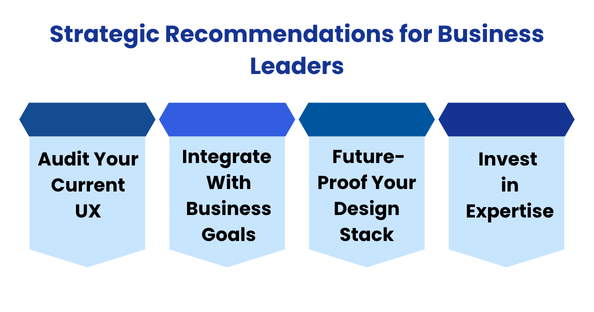
1. Audit Your Current UX
You must begin with a microinteraction audit to break down and understand all the ongoing UX designs and features, and identify where user feedback is weak or inconsistent. This will help you to map a better and enhanced user experience plan to improve UX.
2. Integrate with Business Goals
Make sure that every UX improvement aligns with KPIs. Are you trying to reduce support queries? Increase app engagement? Let micro-interactions serve those targets. A well-qualified user experience consultant can also help you set the goals and improve UX.
3. Invest in Expertise
Partner with a user experience consultant who understands strategic UX improvements at scale. Expert insight can save millions in redesigns and lost conversions.
4. Future-Proof Your Design Stack
Try to choose frameworks and design systems that support scalable, performance-optimized micro-interactions. These investments will support long-term user experience enhancement. Micro interactions 2025 will be way ahead of what you have been familiar with till now.
Conclusion: Transforming Small Details Into Strategic Success
Business leaders, in any industry, are no longer expected to just approve UX budgets; they are expected to understand them as growth levers. Micro interactions are not another design polish needed for UX improvements, they’re a foundational layer of modern user experience services that will impact the perception, performance, and profitability of your company.
In 2025, organizations that commit to purposefully designed, future-forward micro-interactions position themselves as innovators. They don’t just improve UX, they lead markets by making every digital moment count.
Now is the time to enhance user experience with intent. Partner with Resourcifi and hire professional UX developers to enhance your app’s UX with experienced designers providing user experience services. We can help you achieve your business goals.
It’s not about adding motion – it’s about adding meaning, and with it, measurable impact.