
 iOS
iOS Android
 React Native
 Unity
Unity Flutter
 Ionic
Ionic IOT
IOT OTT
OTT Wearable
 Angular
 Python
 Vue.js
 Node.js
 PHP
PHP Laravel
 .Net
.Net WordPress
 Shopify
 Drupal
 Magento
 Social Media Marketing
 PPC Expert
 Content Writers
 GEO
GEO
 Virtual Assistants
 IT Support
 Customer Support
 Order Processing
 Contract Reviewers
 Logistics Coordinator
 eCommerce Solutions
 Bookkeeping
 Tax Preparation
 AR/AP Specialists
 Automation Testing
 Manual Testing
 AI Developer
 ML Developer
 RPA Developer
 UI/UX Designer
 Graphic Design
 Animation
 3D CAD
Do you know what one of the most pivotal choices is, if you are planning for mobile app development? It’s choosing between native app vs hybrid app development.
This decision will not only have a profound effect on your initial investment and time-to-market, but also on the long-term performance, scalability, and user engagement of your app.
If you are a leader responsible for making the crucial decisions for your business, having an understanding of native app vs hybrid app development is of paramount importance.
And we are going to help you with the same. With this blog, we will delve deep into the core distinctions, strategic advantages, and considerations to assist you in making informed decisions while navigating through this digital field.
Understanding Native and Hybrid Applications
For you to effectively navigate through the app development curve, a clear understanding of the Hybrid application vs native app is of paramount importance.
As it is clear from the terms, native applications are those which are built specifically for a single operating system, such as iOS, Android, using the specific language dedicated to that platform, such as
- iOS- Swift, Objective-C
- Android- Java, Kotlin
And specific development tools like-
- iOS- Xcode
- Android- Android Studio
You can think of a native app as a tailor-made solution specific to an individual or requirement, ensuring maximum functionality. Native apps also stick to the design guidelines and UI conventions of their respective platforms, ensuring a digital experience that well well-fitted to your users’ needs.
In contrast to native applications, hybrid applications are built using technologies involving HTML, CSS, and JavaScript. Following this, they are stored in a native container using tools like Cordova, Ionic, or React Native, allowing them to function on multiple platforms from a single code base.
When you launch a hybrid app, you are necessarily interacting with a web browser embedded with a native application wrapper. This wrapper helps you gain access to native device features via plugins, hence bridging the gap between the web code and your device’s hardware.
The main attraction of hybrid app development is credited to its ‘write once, run anywhere’ mechanism. This efficiency makes hybrid app development a well-sought-after option if you are looking for a broad reach and rapid market entry.
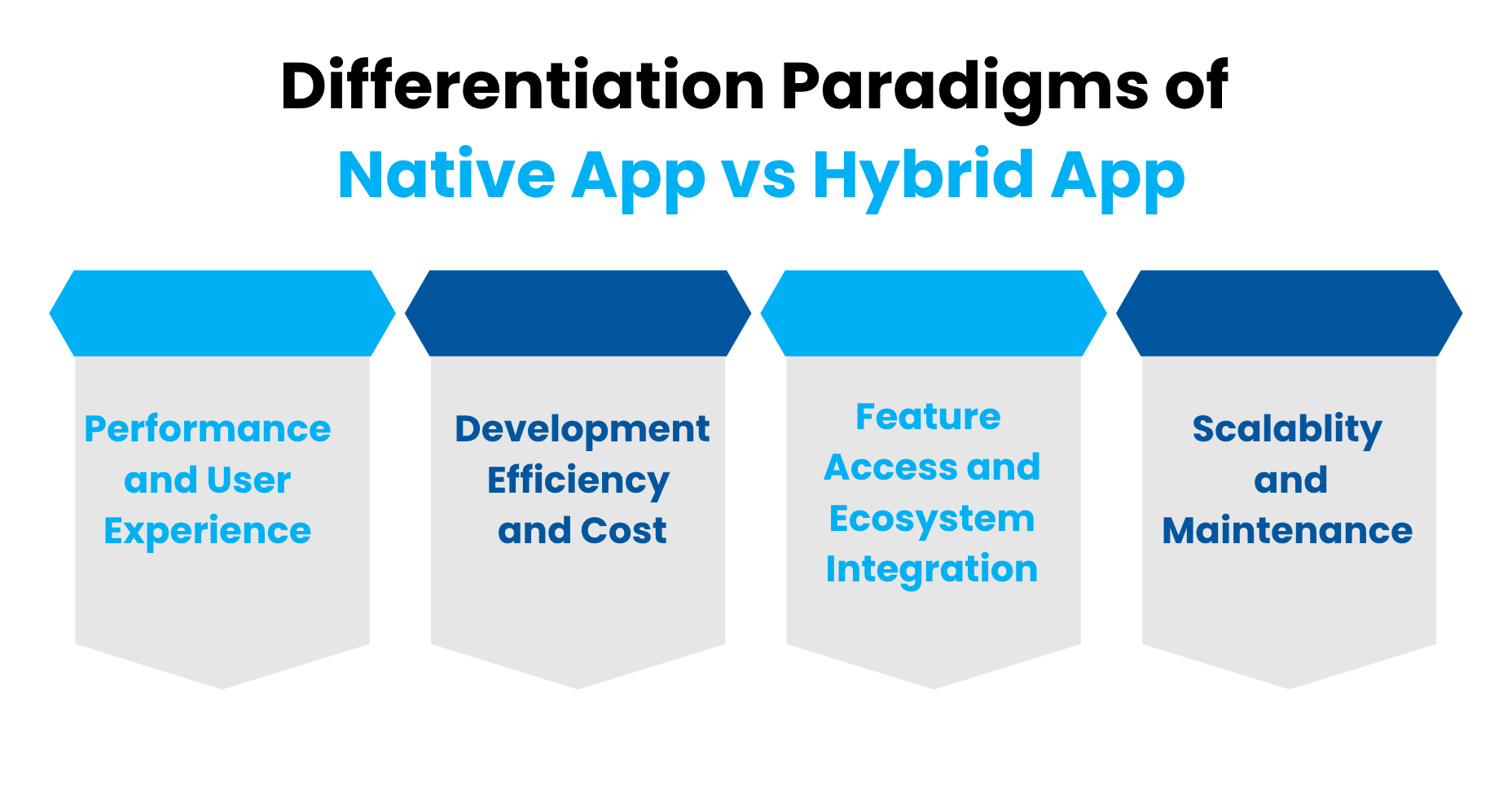
Now that you have gained a basic understanding of native vs hybrid app. Let us go into their further contrasting paradigms.
Performance and User Experience
When evaluating native app vs hybrid app, performance and user experience are the primary considerations to look after.
For any app, the user’s understanding of speed, responsiveness, and fluidity is directly correlated to the app’s engagement, retention, and ultimately the success of the app.
And this is exactly where the inherent difference in the architecture of native app vs hybrid app becomes highlighted and impactful.
-
Native apps
They offer superior performance, speed, and responsiveness, as they are built specifically for a platform, utilizing native APIs and system resources directly. This direct interaction often results in smoother animations and faster loading times.
-
Hybrid apps
Though they are becoming more capable, they may often face inherent limitations in matching their raw performance when native app vs hybrid app is concerned.
While the obvious advancements in hybrid app development frameworks such as React Native, Ionic, and Flutter have drastically reduced this performance gap, you should compare whether the absolute performance of hybrid app development frameworks aligns with your specific use cases.
Always remember, while comparing native vs hybrid apps in a highly competitive market, user perception and their needs should be your primary reference.
Development Efficiency and Cost Implications of Native vs Hybrid App
A significant decision point of hybrid app development vs native app development is the financial and temporal aspects. These factors concerning native app vs hybrid app directly impact budget setting, resource management, and market positioning.
Having an understanding of the efficiencies and demands of each framework is essential for optimizing returns on the app’s initiatives.
Hybrid App Development
The major achievement of hybrid app development frameworks is developing a single codebase and being able to deploy it across multiple platforms like iOS and Android.
This aspect translates effectively into smaller development timelines and the resulting overall costs. Instead of employing two different teams of specialized native developers, you can leverage a unified team skilled in HTML, CSS, and JavaScript.
If you are a startup or business with limited budget capability, hybrid app development offers a compelling value proposition.
Native App Development
In native app development, the initial cost of development is higher as it requires a specialized set of teams for developing separate apps for iOS and Android.
The dedicated team of developers works on distinct codebases with distinct requirements. This naturally increases the initial cost of native app development.
However, the higher initial investment pays off in the form of long-term superior performance, premium user experience, and deep feature integration, which facilitates higher user engagement and gaining a significant differential edge over the rest of the competition in the market.
Feature Access and Ecosystem Integration in Native vs Hybrid App Development
A critical factor in the native vs hybrid app lies in the extent of access to device-specific features and platform ecosystems. This factor can contribute heavily to the richness of the app, impacting every aspect from immersive user experiences and fundamental security features.
Native Application Development
Native applications have unrestricted access to all the device features like GPS, accelerometer, biometric sensors, and the software functions lying under the operating systems.
Native apps also seamlessly integrate with platform-specific guidelines, elevating the overall user experience.
If you are some looking for a user experience involving complete immersion and optimum utilization of every feature of the app, native app development can provide you a smooth pathway.
Hybrid App Development
Hybrid apps can access most of the device features through plugins, but hybrid app development frameworks may face some hindrance for exceptionally specific, newly released functions.
This dependency on plugins means possible delays and less performance compared to its native peers.
However, for most of the features like location services and push notifications, hybrid app development frameworks have sturdy and widely supported solutions.
In light of the above-mentioned points, it can be rightly said that direct access to features remains a key aspect of the native vs hybrid app decision.
Scalability, Maintenance, and Future Proofing in Native vs Hybrid Applications
While deciding between native vs hybrid app, considering the long-term functionality and operational aspects of the frameworks is essential.
As you must have understood by now that your app’s success doesn’t depend just on the initial launch; it’s also about the ability to grow, scale, and remain relevant over time.
Native App Development
It can appear more complex to scale it across platforms, as you are required to manage distinct codebases. This process can involve a lot of resources and requires constant attention to detail from the development team, making it difficult to manage.
However, within their respective ecosystems, native apps are highly sturdy and scalable.
Hybrid App Development
Due single codebase, hybrid app development offers you a more streamlined approach to scaling across platforms in comparison to a native app vs hybrid app.
Updates and bug fixes can be implemented once and used multiple times across multiple platforms. This unified approach is highly beneficial for you if you are looking for efficiency in your operations and a consistent user experience.
Read this blog to find out about tools that can further help to streamline your app development process.
Now that we have understood the different paradigms of native app vs hybrid app development, let’s move on to exploring how you can decide if you are to choose native app development or hybrid app development.
Native App vs Hybrid App Development: Which One to Choose?
It must be very clear to you that the question of hybrid app vs native app is not about one being better than the other, but rather about which aligns better to your needs and your organization’s strategic objectives.
The optimal choice arises from a careful alignment of business priorities with the technical skillsets.
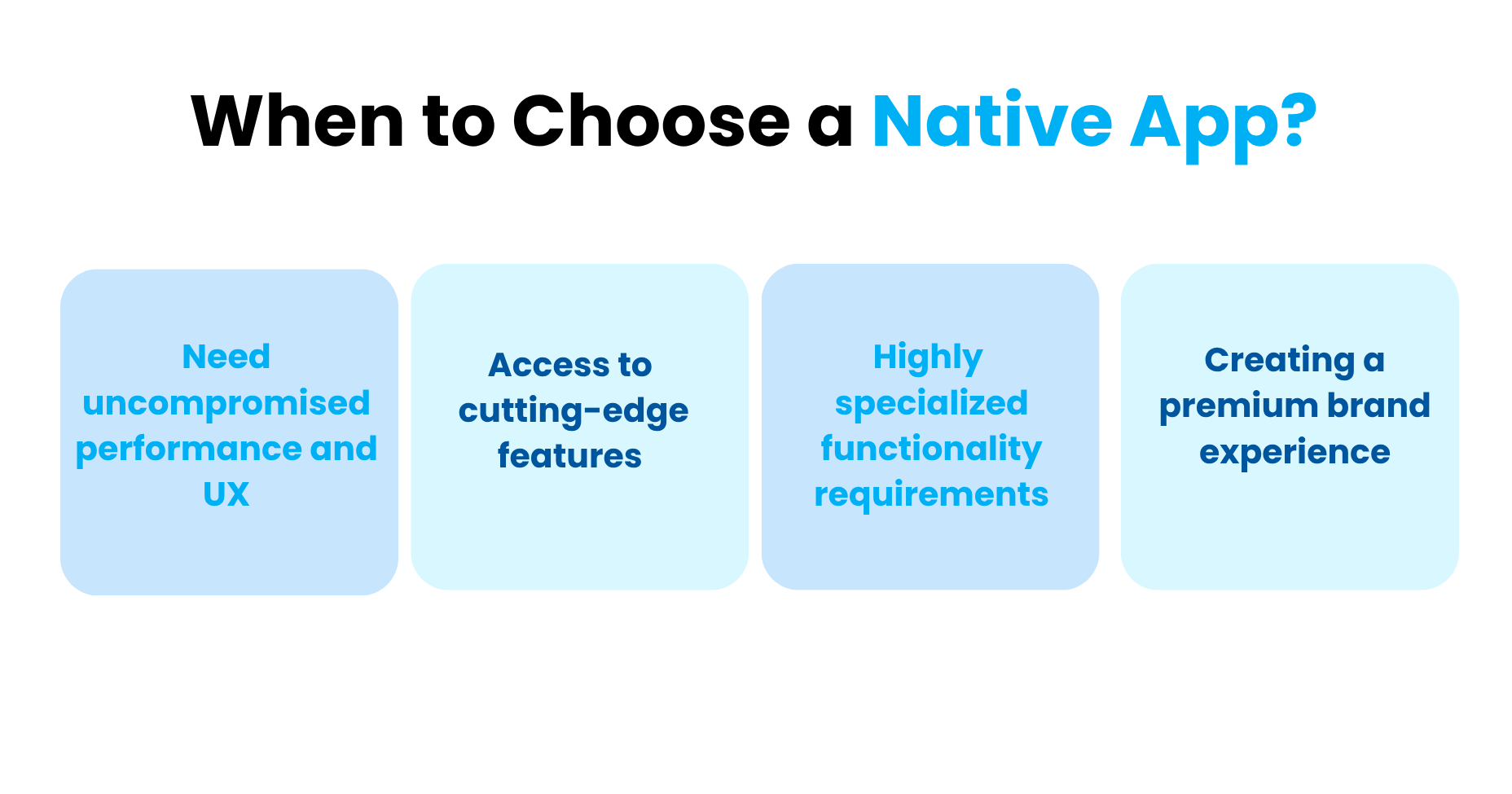
You can consider Native App Development if your business needs and strategy prioritize the following points,
- Uncompromising Performance and UX
- Access to Cutting-Edge Device Features
- Complex or Highly Specialized Functionality
- Brand Differentiation through Premium Experience

You can go for hybrid app development if your business strategy prioritizes,
- Rapid Market Entry and Cost Efficiency
- Broader Audience Reach with Efficiency
- Leveraging Existing Web Talent
- Content-Driven or Standard Feature Application

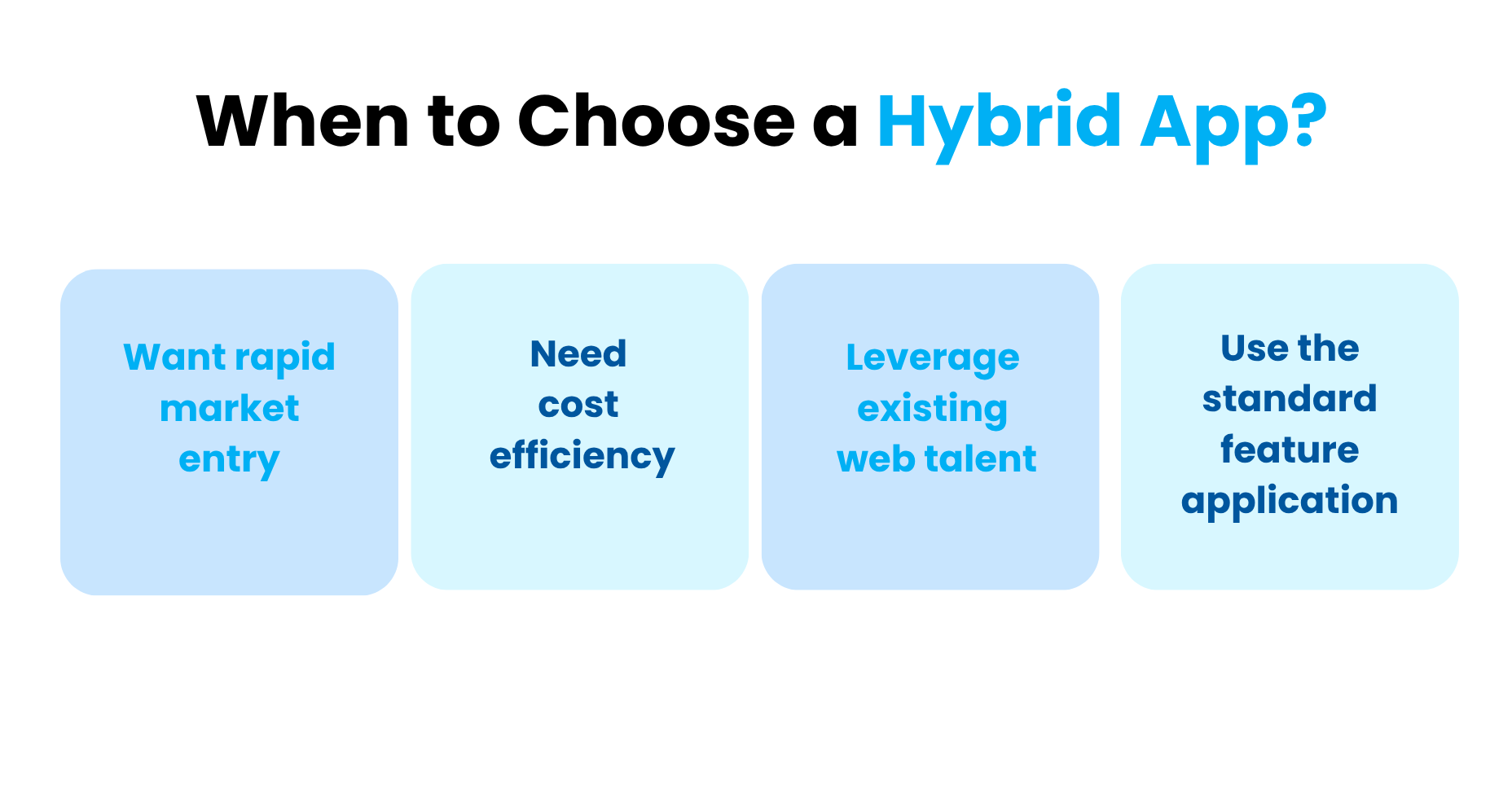
By focusing on the above-mentioned points, you can easily make a choice between a native app vs hybrid application.
Conclusion
The choice between hybrid app development and native app development represents a strategic step for your business and not just a technical one. It is essential for the evaluation of business goals, technical requirements, long-term visions, and financial constraints.
However, the choice between native app vs hybrid app is not a one-size-fits-all decision; what framework works for the other organization might not work for you.
While native app development can provide you with unparalleled performance and access to device features, it comes with higher development costs and longer timelines. Conversely, hybrid app development provides an easier pathway for efficiency and rapid market entry.
By careful consideration of these features of frameworks against your specific business needs. This strategic choice will support your business objectives and deliver sustained value in the competitive digital arena, transforming your vision into tangible digital success.