
 iOS
iOS Android
 React Native
 Unity
Unity Flutter
 Ionic
Ionic IOT
IOT OTT
OTT Wearable
 Angular
 Python
 Vue.js
 Node.js
 PHP
PHP Laravel
 .Net
.Net WordPress
 Shopify
 Drupal
 Magento
 Social Media Marketing
 PPC Expert
 Content Writers
 GEO
GEO
 Virtual Assistants
 IT Support
 Customer Support
 Order Processing
 Contract Reviewers
 Logistics Coordinator
 eCommerce Solutions
 Bookkeeping
 Tax Preparation
 AR/AP Specialists
 Automation Testing
 Manual Testing
 AI Developer
 ML Developer
 RPA Developer
 UI/UX Designer
 Graphic Design
 Animation
 3D CAD
Flutter vs React Native is a constant debate and a pressing question for business leaders around the globe. As the native mobile app development and maintenance of both iOS and Android get expensive, Flutter app development, on the other hand, offers cost savings and cross-platform functionality. However, native development remains hard to beat, especially for projects with specific performance requirements, complex UI/UX needs, or a strong reliance on platform-specific features.
If you’re planning to build a mobile app in 2025, you’re probably staring down the same crossroads that every modern tech leader faces: React Native vs Flutter app development, what to choose? This decision isn’t just about frameworks, it’s about the future of your product, business goals, and project requirements.
Honestly, the stakes are high. Today, users expect frictionless performance and native-like interactions. You want a clean code, rapid deployment, and flexible architecture. It is important to keep a check on time-to-market, scalability, and tech debt, all while making sure you’re not locked out.
That’s where the Flutter vs React Native debate gets real. Flutter is backed by Google, promising a unified UI experience across mobile, web, and desktop. React Native, rolled out by Meta, thrives on the familiarity of JavaScript and a massive developer ecosystem.
Let’s dive into the comparison that’s shaping mobile strategies across industries. This blog will help you understand that it’s not just about features or fandoms. It’s about ROI-driven decisions, platform maturity, and how each framework aligns with the digital roadmap you’re sketching out for your business.
What’s at Stake in 2025 for Cross-Platform Leaders?
The choice you make between Flutter vs React Native will have a direct impact on your ROI, customer lifetime, and long-term salability. Both Flutter app development and React native mobile app development solutions offer the ability to build cross-platform apps from a single codebase. Businesses are turning to these frameworks to reduce development costs, shorten time-to-market, and maintain feature parity across iOS and Android, without managing two separate codebases.
In high-growth environments, time is capital. The speed at which a business can iterate, deploy, and scale directly influences its ability to capture market share. That’s why more product teams are steering away from traditional native mobile app development, which often results in longer development cycles and higher maintenance overhead.
Cross-platform frameworks are now the de facto standard for businesses looking to balance performance, cost-efficiency, and developer velocity. The decision between React Native vs Flutter should therefore be framed around broader business goals, such as:
- Can the framework support rapid MVP launches with future scalability in mind?
- How easily can development teams onboard and collaborate across platforms?
- What are the long-term costs of maintenance, upgrades, and performance optimization?
In 2025, the right choice aligns not only with current development needs but also with the company’s technology roadmap, talent availability, and scalable infrastructure. One needs to build a sustainable ecosystem around it.
Flutter vs React Native: Why They Matter?
Flutter vs React Native– both frameworks offer modern solutions to the challenge of native mobile app development, but they are built on fundamentally different philosophies.
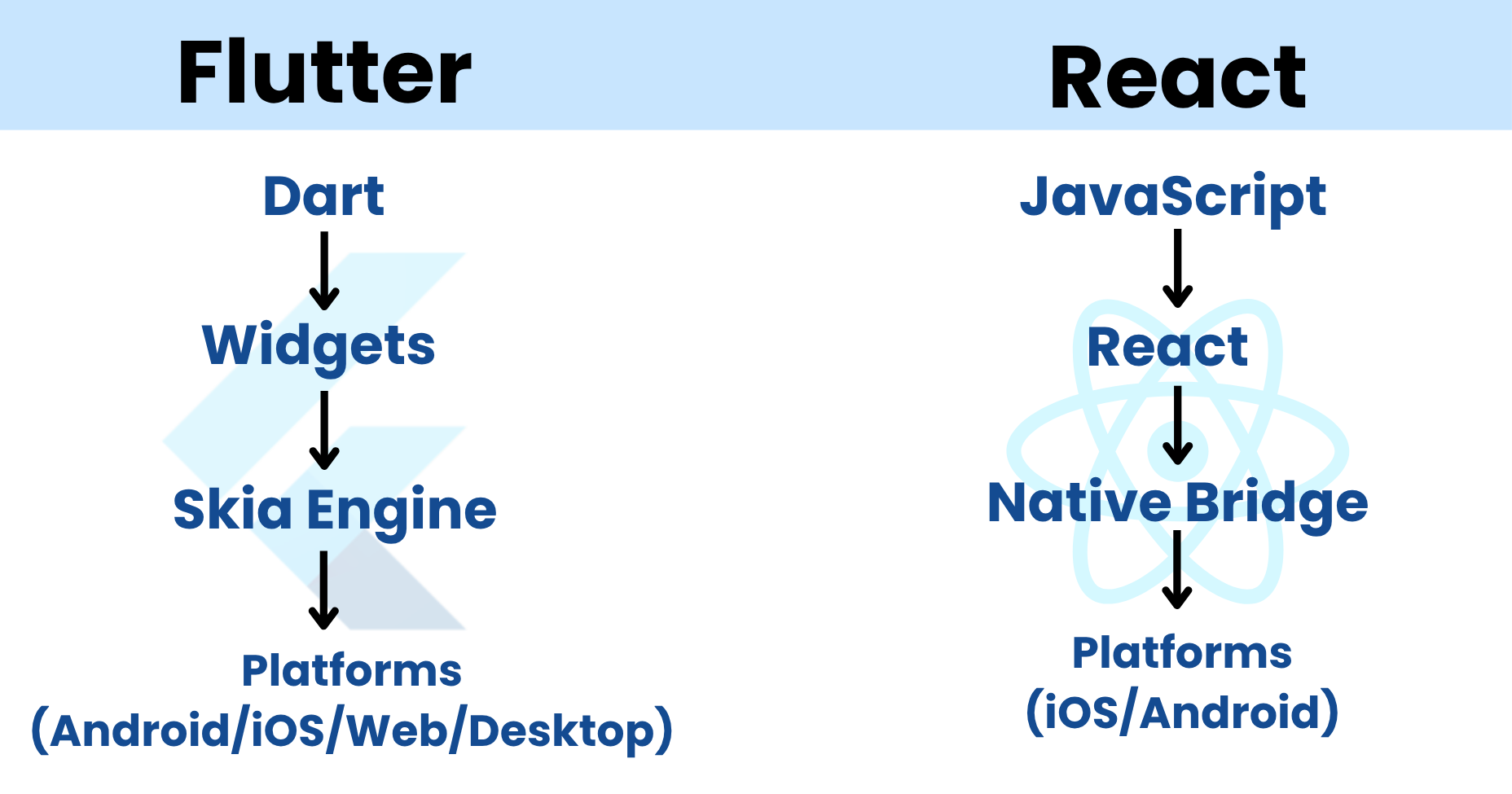
Flutter, developed by Google, is an open-source UI toolkit built on the Dart programming language. Flutter app development uses its rendering engine—Skia—to draw every component directly on the screen, unlike traditional frameworks that rely on platform-specific UI elements. This gives developers unmatched control over the user interface, enabling pixel-perfect design and uniform behavior across Android, iOS, web, and even desktop platforms.
Flutter app development is particularly attractive to product teams because of its ability to deliver high-performance applications with a single, consistent codebase, without compromising on UI flexibility or responsiveness. It’s especially valuable for brands that prioritize strong visual identity and fast frame rates across devices.
On the contrary, React Native, backed by Meta, functions on the power of JavaScript and React in the mobile ecosystem. It operates by translating JavaScript code into native components through a bridge, allowing developers to maintain the “look and feel” of a native app while building from a shared codebase. React Native is highly favored by businesses that already use React on the web, as it allows teams to move faster and leverage existing JavaScript skill sets.
From a team-building and resourcing perspective, there are key differences worth noting:
- Businesses looking to hire Flutter app developers typically benefit from a focused pool of engineers who specialize in Dart and cross-platform UI performance.
- Organizations choosing to hire React Native app developers can tap into a wider JavaScript ecosystem, making recruitment and scaling more efficient in larger teams.
Both frameworks offer robust alternatives to traditional native mobile app development, eliminating the need to maintain separate codebases for iOS and Android. They also drastically reduce development timelines, an increasingly critical factor in markets where speed-to-launch can define competitive advantage.

2025-Specific Updates & Trends
The debate on Flutter vs React Native has evolved to a point that now they represent distinct versions of what the future of mobile app development should look like. These updates reflect not just technological enhancements, but strategic signals and each ecosystem charting its own path in performance, flexibility, and platform ambition.
Flutter in 2025: Beyond Mobile
Google’s vision for Flutter has always extended beyond smartphones, and by 2025, that ambition has materialized at scale.
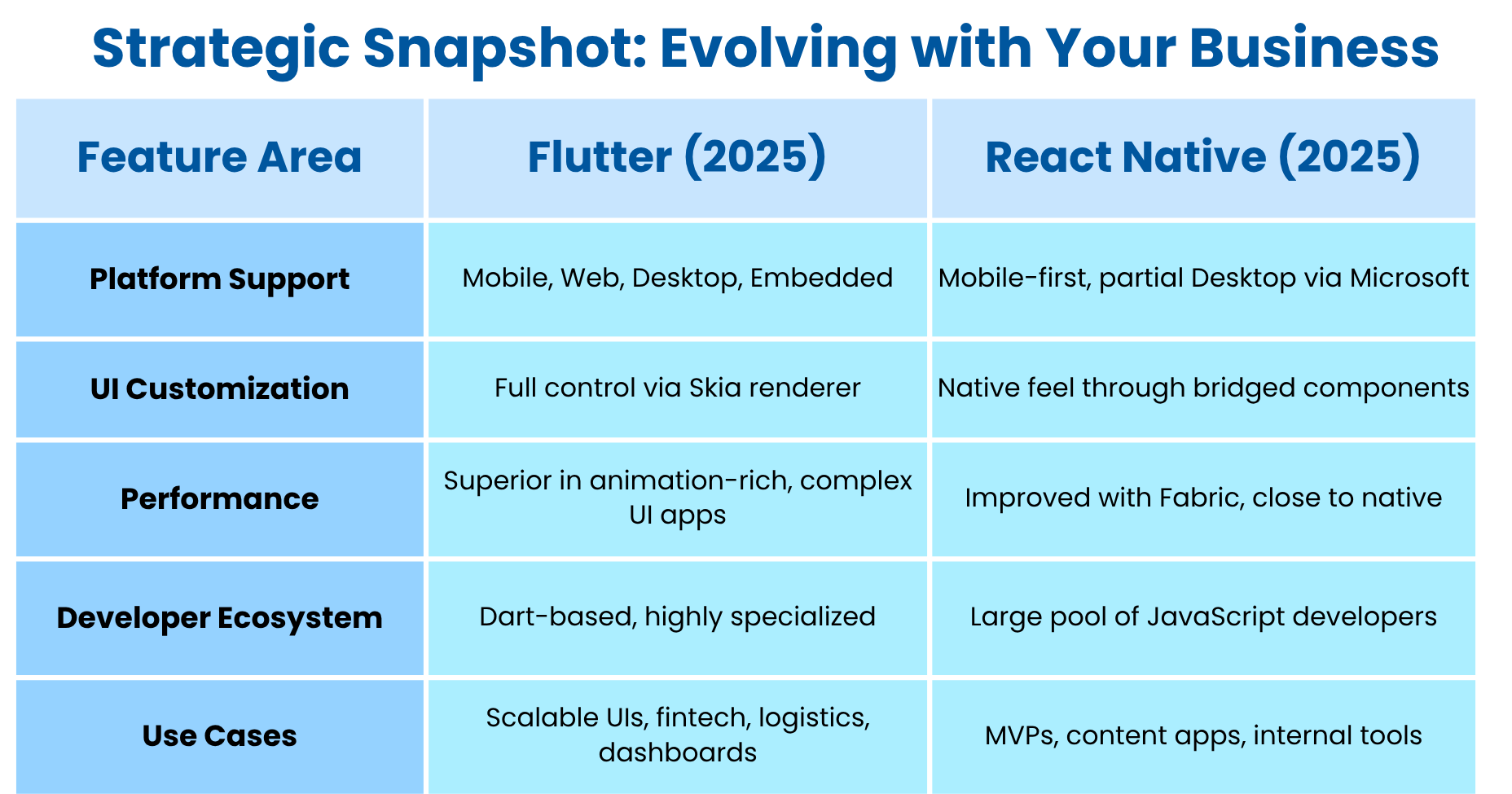
- Flutter 3.x now supports stable output across mobile, web, desktop, and even embedded devices. Using a single codebase, companies can target iOS, Android, Windows, macOS, Linux, and web browsers. This will significantly reduce overhead and speed up rollout across touchpoints.
- The integration with Material 3 design principles has also matured, enabling more visually cohesive and brand-aligned user interfaces across platforms.
- In performance benchmarks, Flutter continues to outpace other frameworks in UI rendering speed and animation fluidity. The framework’s reliance on its own rendering engine has proven valuable for apps that prioritize custom interactions, such as fintech dashboards, health trackers, and on-demand services.
- Integration with Firebase, AI/ML SDKs, and Google Pay is now deeply embedded in the core development experience, making Flutter app development an ideal choice for businesses that are investing in smart, data-driven user experiences.
More notably, enterprise adoption is on the rise. In 2025, Flutter powers digital solutions for brands like Toyota, eBay Motors, and several Fortune 500 companies that require consistent cross-platform UI and robust performance without relying on native teams.
Businesses opting to hire Flutter app developers can find these advancements translate into measurable ROI and reduced time to market, lower design debt, and increased UI consistency across all user touchpoints.
React Native in 2025: Deeper Roots, Smarter Bridges
Meanwhile, React Native has continued to refine its bridge-based architecture and solidify its position in organizations with deep JavaScript expertise.
- The introduction of TurboModules and the Fabric renderer has greatly improved performance and responsiveness, eliminating much of the latency that early versions were criticized for.
- 2025 sees stronger integration with the broader React ecosystem, including React Server Components and Concurrent Rendering, making React Native apps feel more reactive and lightweight than ever.
- Investment from Microsoft (React Native for Windows/macOS), Vercel, and Expo has made it easier for developers to build, deploy, and test at scale.
- React Native mobile app development continues to dominate in startups and product teams where JavaScript is already core to the tech stack. It provides a gentler learning curve, which reduces onboarding time and allows faster MVP delivery.
Major players like Shopify, Discord, and Facebook have adopted react native mobile app development, and the framework demonstrates long-term viability at a massive scale. For businesses with distributed teams or tight release cycles, the ability to hire React Native app developers easily remains a key advantage.
Cost Implications: Development, Hiring & Long-Term ROI
When evaluating Flutter vs React Native, one of the most critical considerations for business leaders is cost; not just initial development expenses, but total cost of ownership (TCO) over time. The right framework should reduce both immediate and long-term spending across design, development, and maintenance.
Development Efficiency in React Native vs Flutter
Both Flutter and React Native support a single codebase for Android and iOS, which inherently reduces development hours and overhead compared to traditional native mobile app development. However, the level of efficiency achieved varies depending on team structure and application complexity.
- Flutter app development offers high velocity in building unified interfaces, especially when visual consistency is key. The hot reload feature and widget-based architecture enable faster iteration with fewer bugs.
- React Native benefits from JavaScript’s ubiquity, making it easy to assemble teams and reuse existing code from web applications. This is particularly cost-effective for startups and mid-sized teams moving quickly toward an MVP.
Hiring & Talent Availability in React Native vs Flutter
The availability and cost of talent also play a role in platform selection.
- Companies aiming to hire React Native app developers generally benefit from a wider pool, thanks to JavaScript’s dominance in the global dev community.
- Businesses that choose to hire Flutter app developers may encounter a more specialized talent pool, but benefit from expertise focused on performance optimization and cross-platform scalability.
Maintenance & Upgrades in React Native vs Flutter
Flutter’s unified rendering layer means fewer platform-specific issues, which reduces long-term maintenance costs. React Native, while mature, may require occasional custom bridging to access native APIs, adding complexity as the app grows.
Strategic Takeaway
- For design-heavy apps with long-term scalability goals, Flutter app development can reduce tech debt and streamline updates.
- For MVPs or products built within existing web-focused ecosystems, React Native mobile app development offers faster team ramp-up and immediate cost savings.
Ultimately, the best ROI comes from aligning the framework with your team’s capabilities, the complexity of your app, and your business’s scaling trajectory.
React Native vs Flutter Case Studies
Beyond frameworks and features, the Flutter vs React Native debate comes to life through real-world impact. Both techs have helped companies achieve measurable success in different scenarios, from performance gains to faster market launches.
Performance and Brand Experience with Flutter App Development
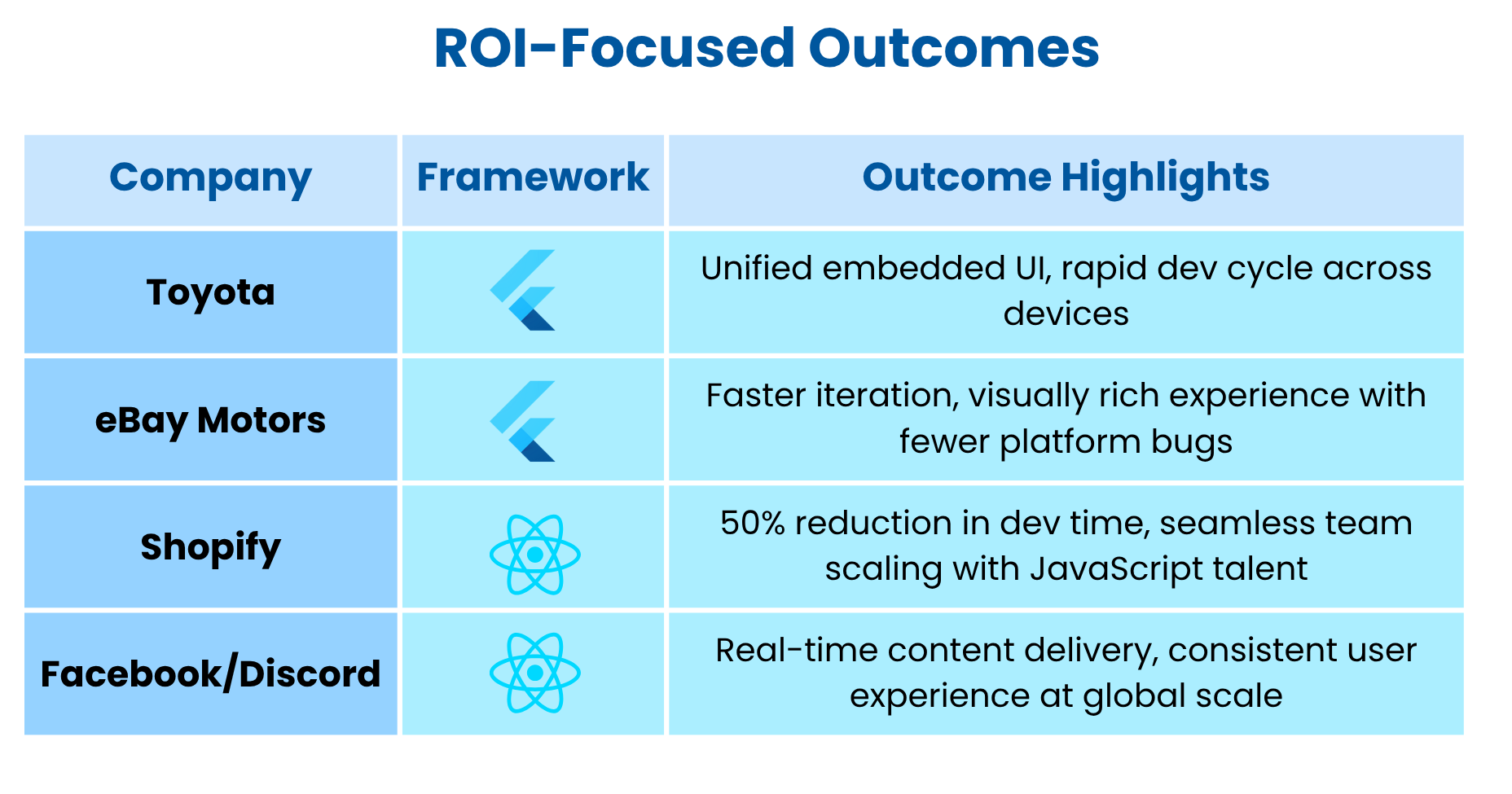
Toyota, one of the world’s most recognized brands, adopted Flutter app development to power its next-generation infotainment systems. The need for a highly customized, reliable UI across multiple hardware configurations made Flutter app development is the logical choice. By using a single codebase, Toyota accelerated development across embedded systems while maintaining strict visual consistency and reducing platform-specific bugs.
Similarly, eBay Motors rebuilt its app using Flutter to deliver a modern buying and selling experience. The platform’s ability to render complex UIs with native-like fluidity allowed eBay to innovate rapidly while keeping user experience at the forefront. The team reported improved development speed, fewer regressions, and a more unified codebase between Android and iOS.
Speed, Scale, and Familiar Tools with React Native Mobile App Development
Shopify, a global eCommerce platform, transitioned several of its mobile apps to React Native, citing faster onboarding and better alignment with its existing web development practices. With thousands of merchants relying on their app, Shopify leveraged React Native to build cross-platform experiences at scale, cutting their mobile development cycle time in half while maintaining high performance standards.
Facebook and Discord, two communication giants, continue to scale their core mobile apps with React Native. Both platforms emphasize real-time interaction and dynamic content delivery—areas where React Native’s JavaScript foundation and asynchronous rendering offer a strategic edge.
These examples show that whether a company chooses to hire Flutter app developers or hire React Native app developers, success hinges on aligning the framework with product goals and internal capabilities.
What Should You Choose?
Flutter vs React Native ultimately comes down to strategic alignment and how well each framework fits your business model, tech team, and growth vision. While both options support cross-platform efficiency, their strengths shine under different conditions.
Here’s a breakdown to help product leaders, CTOs, and founders make an informed choice:
Choose Flutter app development if your priorities include:
- High-performance animations and custom UI
- Consistent brand experience across platforms (mobile, web, desktop)
- Long-term scalability with a single codebase
- Fewer runtime issues and minimal platform divergence
- You’re building apps in industries like fintech, automotive, or enterprise SaaS
Businesses that are ready to invest in consistency, speed, and future expansion often choose to hire Flutter app developers for superior control and UI output.
Choose React Native mobile app development if your priorities include:
- Faster MVP delivery with existing web talent
- JavaScript-first development culture
- Cost-effective scalability in content or utility-based apps
- Quick iterations and access to a broad developer ecosystem
- You’re focused on startups, eCommerce, or consumer communication apps
Companies that are looking to move fast while leveraging web-native skills often hire React Native app developers to scale rapidly with minimal friction.
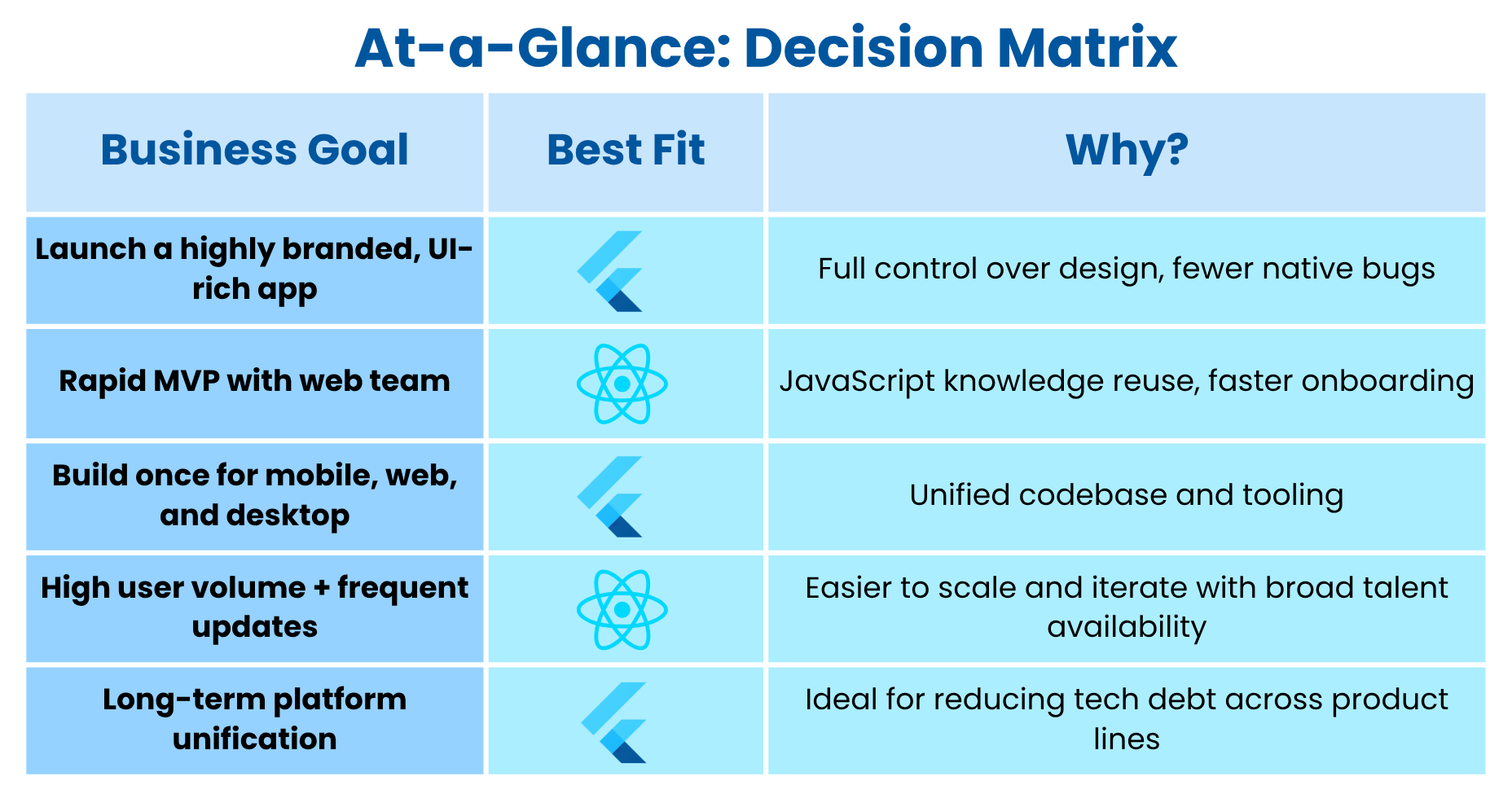
By mapping technical capability to business intent, this matrix helps organizations avoid over-engineering and under-delivering. In the next and final section, we’ll zoom out and examine what this decision means for long-term digital strategy.
Conclusion
As mobile technology continues to evolve in 2025, choosing the right development framework isn’t just about shipping an app, it’s about setting up a scalable, future-ready foundation. The decision between Flutter vs React Native carries long-term implications for product velocity, team efficiency, customer satisfaction, and innovation potential.
Both frameworks offer robust support for cross-platform development, but their strengths play out differently depending on your goals:
- Flutter app development shines when visual consistency, performance, and platform unification are top priorities.
- React Native mobile app development, on the other hand, provides a fast, flexible path forward—especially when leveraging existing JavaScript talent or launching iterative MVPs.
Teams that hire Flutter app developers typically aim for unified long-term experiences across mobile, web, and desktop. Those who hire React Native app developers tend to prioritize time-to-market and integration with existing front-end workflows.
What matters most is not the framework itself, but how it aligns with your company’s digital roadmap. The best technology decisions are those that reduce complexity, accelerate innovation, and keep your team moving forward – not just in 2025, but for the years ahead.
If your mobile product is central to customer experience, retention, or revenue growth, investing in the right platform is more than a technical call; it’s a business imperative.