 iOS
iOS Android
 React Native
 Unity
Unity Flutter
 Ionic
Ionic IOT
IOT OTT
OTT Wearable
 Angular
 Python
 Vue.js
 Node.js
 PHP
PHP Laravel
 .Net
.Net WordPress
 Shopify
 Drupal
 Magento
 Social Media Marketing
 PPC Expert
 Content Writers
 GEO
GEO
 Virtual Assistants
 IT Support
 Customer Support
 Order Processing
 Contract Reviewers
 Logistics Coordinator
 eCommerce Solutions
 Bookkeeping
 Tax Preparation
 AR/AP Specialists
 Automation Testing
 Manual Testing
 AI Developer
 ML Developer
 RPA Developer
 UI/UX Designer
 Graphic Design
 Animation
 3D CAD
“How long does it take to make an App?” – This is one of the top three questions our clients are interested in (the first obviously being about “how much it costs to build an app?”). It is a very fair question to ask, especially as we live in the era of artificial intelligence, where tasks are marked to be completed within a few days. However, to develop an application from scratch not only requires precision and knowledge but also years of experience. That’s where Resourcifi steps in.
To answer your question, it typically takes 3 to 9 months to make an app, depending on complexity, platform, and team structure. A simple MVP can be built in under 4 months, while enterprise-grade applications can take over a year. You must understand the timeline clearly for strategic planning, budgeting, and execution.
Why This Question Matters for Decision-Makers?
If you’re a CEO, CTO, or product head trying to map out your digital strategy, one of the first questions you’re likely asking is: “How long will it take to build our app?” It’s a deceptively simple question, but still, the answer to this will drive your entire game plan. It is one of the prime questions to ask before you step into the app development process, and the answer will have a great impact on everyone’s Jira tabs!
There’s no one-size-fits-all answer. The time it takes to develop an application depends on a range of variables, such as your product’s features, the platform(s) you’re targeting, and how quickly your team can iterate. When a company fails to set a clear expectation upfront, it faces major delays and budget overruns.
This blog is built to remove that uncertainty.
By the end of this blog, you’ll not only have a clearer answer, but you’ll be better equipped to make confident, well-informed decisions that align with your business goals.
Know the timeline of the app development process as it impacts the business outcomes:
- Go-to-market alignment: If you’re planning a product release, investor pitch, or launch campaign, you need an accurate estimate of how long it takes to make an app. You cannot afford to rely on guesswork.
- Resource planning: When you outsource your mobile app development, process (or hire internally or hire mobile app developers), knowing the mobile app development timeline helps with budgeting, staffing, and contractor negotiations.
- Competitive advantage: In saturated markets, time-to-market can be the difference between being a trendsetter and a latecomer.
- Cost control: Projects that exceed the expected application development time typically incur higher costs and more scope creep.
According to a 2024 Statista report, 45% of app development projects for U.S. businesses faced delays due to underestimating initial timelines.
How Long Does It Take to Make an App?
Decision makers should and generally are always worried about how long it takes to develop an app, and while there is no universal answer to calm their nerves, there are some proven industry benchmarks based on the app’s complexity, platform choice, and feature scope. Let’s understand the expected development timeline for different types of applications.
App Development Timelines by Complexity
If you’re estimating the application development time for your next project, you can use the below given table as a practical reference point.
|
App Type |
Typical Timeline | Use Case Examples |
|
Basic App (MVP) |
2 – 4 months | To-do list, calculators, eBooks, note apps |
|
Moderately Complex App |
4 – 7 months | Chat apps, eCommerce, fitness trackers |
| Highly Complex App | 8 – 12+ months |
Marketplaces, on-demand services, and fintech |
However, if you’re targeting multiple platforms, adding advanced features, or integrating with third-party systems, the timeline will vary.
Influencing Factors You Can’t Ignore
The reason how long it takes to develop an app varies so widely is because each app is unique. For example-
- A simple Android task manager app with local storage may take 8–10 weeks.
- A fintech app requiring two-factor authentication, KYC integration, and regulatory compliance could take 10–14 months.
- A cross-platform social app with real-time chat, geolocation, and user analytics might require 6–9 months, even with an experienced team.
This is why having a development partner who can accurately assess scope and timeline is critical. Resourcifi, an app development company specializing in the app development process, has worked with U.S. businesses to define the right-sized product roadmap and development timeline from day one.
>> Learn more about our approach to mobile app development
Even after the app development process is complete, some additional time may be required for:
- App Store & Play Store review and approval (typically 3–7 days)
- User testing and bug fixing (1–3 weeks)
- Stakeholder feedback loops (varies)
Understanding the mobile app development lifecycle helps you prepare for these time buffers and keep your team aligned around realistic launch goals.
Phase-by-Phase App Development Process and Timeline
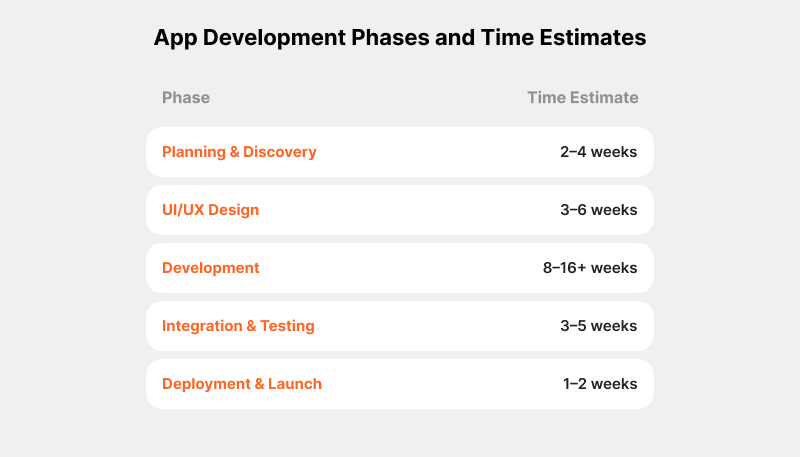
Let’s answer the question, “How long does it take to build an app?” with a detailed process and timeline assessment. The most accurate answer comes from understanding the entire app development process, step by step. Each phase contributes to the total application development time, and skipping or rushing any stage can lead to delays, quality issues, or budget overruns.
Below is a comprehensive breakdown of each development phase, along with time estimates and what to expect.
1. Discovery & Planning (2–4 weeks)
This phase sets the foundation. It’s where you define what you’re building, who it’s for, and why it matters.
What happens in this stage of the app development process:
- Clarifying the product vision and core functionality
- Competitor analysis and user research
- Defining user personas and core user journeys
- Technology stack selection (native vs cross-platform)
- Creating a product roadmap with realistic milestones
- Estimating how long it will take to develop the app based on the scope
Why it matters:
This phase ensures you’re solving the right problem with the right solution before you commit time and budget. It also minimizes scope creep later on.
Time estimate: 2–4 weeks
2. UI/UX Design (3–6 weeks)
In this stage, the user interface (UI) and user experience (UX) are crafted to ensure the app is both functional and intuitive.
What happens in this stage of the app development process:
- Wireframing (low-fidelity screen sketches)
- Prototyping user flows
- High-fidelity designs with branding elements
- Interaction design and usability testing
- Responsive design for multiple devices (especially important in mobile app development)
Why it matters:
Design plays a major role in retention. A well-designed app reduces friction and improves engagement. For C-suite leaders, investing in design early reduces rework costs post-launch.
Time estimate: 3–6 weeks
3. Development (8–20+ weeks)
This is the most time-intensive phase in the entire app development process, and where your product starts taking shape.
What happens:
a. Frontend Development
- Building the visual elements users interact with
- Platform-specific builds (iOS with Swift, Android with Kotlin) or cross-platform frameworks like Flutter or React Native
b. Backend Development
- Database design and cloud infrastructure setup
- Business logic, APIs, and server-side integrations
- User authentication, role-based access, and data handling
c. Third-Party Integrations
- Payment gateways, CRMs, analytics tools, maps, push notifications, etc.
Why it matters:
This phase directly impacts how long it takes to make an app. A modular, well-architected backend can future-proof your app and improve performance.
Time estimate: 8–20+ weeks, depending on complexity
At Resourcifi, we specialize in scalable, modular development for both native and cross-platform mobile apps. Our U.S. clients benefit from shorter release cycles and efficient code reuse.
Explore our mobile app development solutions
4. Testing & Quality Assurance (3–6 weeks)
After development, thorough QA ensures your app works as intended across all devices, operating systems, and use cases.
What happens:
- Functional testing (are features working as expected?)
- UI testing (are screens rendering correctly on all devices?)
- Regression testing (does the latest code break anything?)
- Load & performance testing (can the app handle spikes in traffic?)
- Security testing (especially if you’re collecting user data)
- Device lab testing for Android fragmentation
Why it matters:
Skipping or compressing this phase is a costly mistake. Apps that launch with bugs damage credibility, frustrate users, and often result in costly patch releases.
Time estimate: 3–6 weeks (can overlap with development in Agile teams)
5. Deployment & Post-Launch Support (1–2 weeks for release, ongoing thereafter)
Your app is now ready to be released to the world, but that doesn’t mean the work is over.
What happens:
- App Store and Google Play submission (including compliance checks)
- Metadata, screenshots, and launch assets preparation
- App store approval timelines (usually 3–7 days)
- Crash monitoring and bug fixing
- Collecting feedback for version 2.0
- Planning regular updates and new feature rollouts
Why it matters:
This final phase ensures the app is properly distributed, monitored, and iteratively improved. For U.S. businesses especially, ongoing support is critical for maintaining compliance and performance standards.
Time estimate:
- Initial release: 1–2 weeks
- Post-launch support: Ongoing
Total Estimated Application Development Time
If you’re serious about building a high-quality mobile application, understanding each phase in the mobile app development timeline is essential. It not only helps set accurate expectations but also gives you control over budget, scope, and quality. The clearer your roadmap, the more successful your launch will be.
Up next, we’ll dive into the key factors that influence your app development timeline, because no two apps follow the same path.
Key Factors That Affect Application Development Time
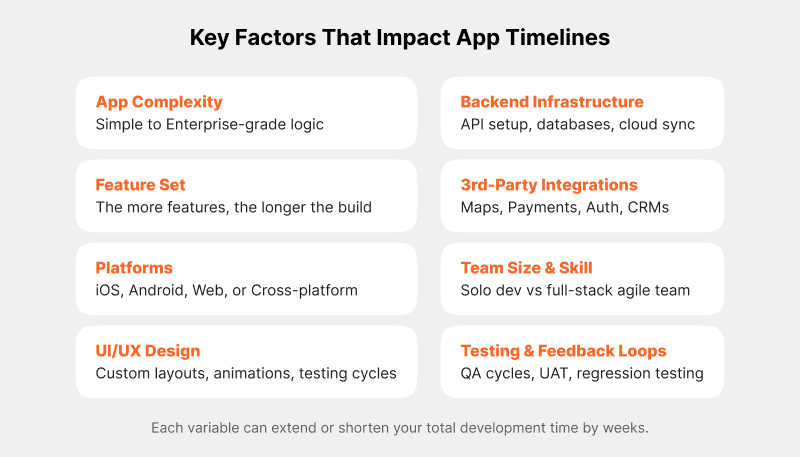
While understanding the standard app development process is helpful, the truth is: no two projects follow an identical timeline. Several variables determine how long it takes to make an app, and overlooking them can lead to underestimation, scope creep, or technical debt.
In this section, we break down the most influential factors that shape your total application development time, especially if you’re planning to build for the U.S. market.
1. App Complexity
The more features your app has, the longer it takes to build and test. This is the most significant factor influencing how long it takes to develop an app.
Examples of complexity drivers:
- Real-time chat functionality
- Geolocation and GPS tracking
- In-app purchases and payment gateway integration
- Data encryption and user-level permissions
- Offline functionality and local data sync
- AI or machine learning components
- Admin dashboards and analytics
Impact on timeline:
A simple utility app with 3–5 screens may take under 3 months. In contrast, a high-complexity healthcare or financial application can easily stretch past 9–12 months due to security, compliance, and data handling.
2. Platform Selection: iOS, Android, or Both
Choosing to build for one platform vs multiple platforms affects both duration and resource allocation.
- iOS-only development is generally faster due to fewer device variations and tighter ecosystem control.
- Android requires additional time for device testing due to OS fragmentation.
- Cross-platform development (using Flutter or React Native) can significantly reduce application development time, especially when targeting both platforms with a single codebase.
Impact on timeline:
Dual-platform native apps often take 30–40% more time than cross-platform alternatives. If your team is time-sensitive, frameworks like Flutter offer significant efficiencies.
Learn more about our Flutter app development services
3. Development Approach: Native vs Cross-Platform
Your tech stack choice can dramatically influence how long it takes to build an app, in terms of both development speed and future scalability.
- Native apps (Swift for iOS, Kotlin for Android) offer optimal performance but require separate codebases and teams.
- Cross-platform apps share code between platforms and are ideal for MVPs, startups, or enterprise apps with feature parity.
Impact on the timeline:
Going native may increase initial build time by 40–50% if you’re targeting both iOS and Android. Cross-platform apps can shorten the timeline and reduce maintenance costs without sacrificing quality, if done right.
4. Team Structure and Development Resources
Whether you choose to develop in-house or partner with an experienced app development company directly impacts your speed to market.
- In-house teams may require onboarding, training, and ramp-up time.
- Freelancers can be cost-effective but often lack project continuity and full-stack capabilities.
- Outsourced partners like Resourcifi offer dedicated development pods, faster ramp-up, and pre-validated workflows—ideal for U.S. companies looking for predictability and scalability.
Impact on timeline:
Outsourcing mobile app development to a trusted partner can reduce delivery timelines by 25–40%, depending on the complexity and availability of internal resources.
Explore how Resourcifi supports faster app development for U.S. clients
5. Compliance, Security, and Data Handling
For industries like healthcare, finance, and e-commerce, compliance is not optional. It adds critical steps to development and testing.
Compliance requirements that may extend the timeline:
- HIPAA for healthcare apps
- ADA for accessibility compliance in the U.S.
- PCI-DSS for handling payments securely
- GDPR/CCPA for data privacy and user consent
Impact on the timeline:
Compliance-related planning, documentation, and security testing can add 4–8 weeks to the total mobile app development cycle, especially when working with third-party APIs and cloud providers.
6. Change Requests and Iterations
Feature changes mid-development are common, but they come at a cost.
If scope changes are not carefully managed, they can lead to delays, increased QA cycles, and misalignment across teams. Agile development can help manage iterations more gracefully, but strong initial planning remains the best way to control application development time.
Every project is different. Your app’s features, target users, business model, tech stack, and regulatory requirements all impact how long it takes to make an app. Understanding these variables early helps you build smarter, plan better, and reduce costly surprises down the line.
How to Develop an Android App?
Android app development offers more flexibility but comes with additional testing and device compatibility requirements. This impacts both how long it takes to develop an Android app and how much testing is required before launch.
Android App Development Process
Key stages:
- Tooling & Language: Android Studio, Kotlin or Java
- UI/UX Design: Must support a wide range of screen sizes and device specifications
- Development: Includes native features, third-party integrations, and background processing
- Testing: Device fragmentation testing across manufacturers (Samsung, Pixel, Motorola, etc.)
- Play Store Submission: Faster than Apple, typically within hours to 1–2 days
Timeline to Develop an Android App
- Simple Android app: 2–3.5 months
- Moderately complex app: 4–6 months
- Advanced Android app: 7–10+ months
Considerations That Add Time
- Device Fragmentation: Android runs on thousands of device types. Ensuring compatibility across screen sizes and OS versions can extend QA timelines.
- Security Practices: Google Play’s new policies (as of 2024) require additional privacy disclosures, data safety labeling, and permissions declarations.
- App Updates: More frequent releases may be required to address device-specific issues post-launch.
Why it matters:
If your target audience includes mass-market users or price-conscious consumers in the U.S., Android offers broader reach. However, its flexibility comes with more rigorous testing requirements and longer QA cycles.
Whether you’re developing for iOS or Android, understanding platform-specific workflows is crucial to accurately estimating how long it takes to build an app. If you’re planning a dual-platform release, cross-platform frameworks like Flutter can help streamline development without duplicating effort.
Explore our Flutter app development capabilities
Next, we’ll share actionable strategies to speed up mobile app development without sacrificing quality, ideal for U.S. decision-makers under tight deadlines.
How to Speed Up Mobile App Development Without Sacrificing Quality?
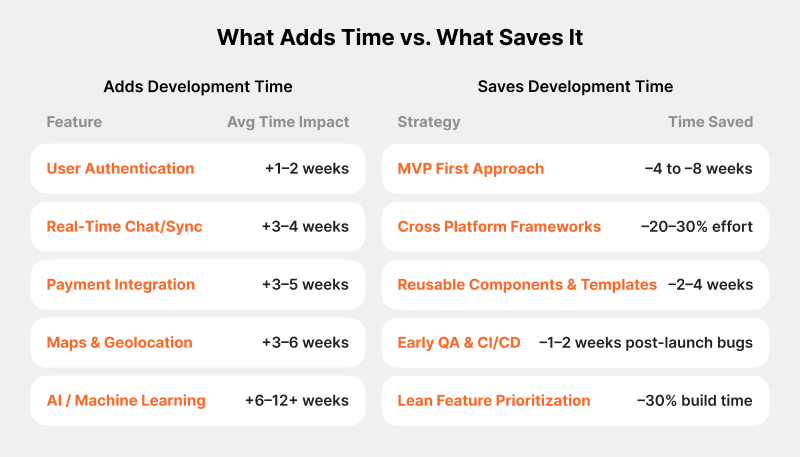
Speed matters—especially when you’re working toward a product launch, funding milestone, or market window. But rushing development without structure can lead to rework, security flaws, and missed expectations. Here are six effective ways to reduce application development time while maintaining quality, scalability, and control.
1. Start with an MVP (Minimum Viable Product)
Instead of building every feature upfront, focus on the essential user flows that prove your core value proposition. This reduces initial development time and allows you to validate your app in the market before scaling. You can then iterate based on real user feedback, saving time and budget downstream.
2. Use a Cross-Platform Framework Like Flutter
Building two separate codebases for iOS and Android adds unnecessary overhead. By using a framework like Flutter, you can develop a single codebase that deploys across platforms. This reduces total mobile app development time by up to 40% without sacrificing user experience.
3. Implement Agile Sprints
Agile project management helps teams focus on high-priority tasks in 1–2 week development cycles. This structure improves communication, keeps the backlog lean, and allows faster iteration. It’s also easier to track progress and catch blockers early, before they delay delivery.
4. Reuse Pre-Built Components
Don’t reinvent the wheel. Reuse authentication modules, notification systems, navigation flows, and analytics integrations whenever possible. These components are stable, tested, and widely supported, reducing both dev effort and QA cycles.
5. Integrate QA Early
Quality assurance should begin as soon as the first build is functional. Running tests in parallel with development ensures bugs are caught early, reduces regression risks, and shortens the final testing phase, keeping your application development timeline intact.
6. Outsource to a Proven App Development Partner
Working with an experienced offshore development partner—like Resourcifi—eliminates ramp-up time and accelerates execution. With ready-to-deploy teams, pre-defined processes, and scalable delivery models, outsourcing can dramatically reduce time-to-market for U.S. businesses.
See how Resourcifi speeds up mobile app development
App Development Time is a Strategic Variable
How long does it take to make an app? The answer isn’t fixed—it depends on your app’s complexity, platform, team structure, and long-term vision. But one thing is certain: having a clear understanding of the app development process helps you plan smarter, budget accurately, and execute with confidence.
For CEOs, CTOs, and product leaders, application development time isn’t just a delivery estimate—it’s a business variable that impacts your product strategy, go-to-market, and ROI. The more informed your decisions are at the outset, the fewer delays and cost overruns you’ll face down the line.
Whether you’re building a lightweight MVP or launching a feature-rich platform, working with an experienced development partner ensures that your timeline works for your business, not against it.
Work With Resourcifi to Accelerate Your App Launch
At Resourcifi, we help U.S.-based businesses design, develop, and deliver secure, scalable mobile apps on time and on budget. Whether you’re exploring native, cross-platform, or hybrid builds, our dedicated development pods bring expertise, speed, and accountability to every engagement.
Let’s turn your vision into a real product. Talk to our experts or explore our mobile app development services.

FAQs: How Long Does It Take to Make an App?
Q1: How long does it take to make an app in 2025?
A: In 2025, building a mobile app typically takes 3 to 9 months, depending on complexity. A basic MVP can be developed in 2–4 months, while advanced apps may take 8–12+ months, especially if they involve custom features, third-party integrations, or regulatory compliance.
Q2: How to develop an iOS app?
A: To develop an iOS app, use Swift in Xcode, following Apple’s Human Interface Guidelines. The process includes discovery, UI/UX design, development, testing via TestFlight, and submission to the App Store. App Store review usually takes 2–7 days.
Q3: How to develop an Android app?
A: Android apps are built using Kotlin or Java in Android Studio. The development includes designing for multiple device types, integrating features, testing across various Android versions, and deploying via the Play Store—often approved within 24–48 hours.
Q4: What’s the fastest way to reduce mobile app development time?
A: Start with an MVP, choose cross-platform frameworks like Flutter, implement Agile sprints, reuse components, and outsource to a reliable partner. These strategies can reduce your application development time by 30–50% without impacting quality.
Q5: Can I build an app in one month?
A: Yes, but only for extremely simple apps with minimal functionality and no backend. Most production-ready apps need at least 2 to 3 months for proper planning, design, development, testing, and deployment.